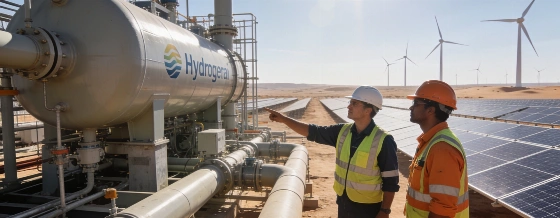
Four major green hydrogen projects in Egypt, Morocco, Namibia, and South Africa will get $20 million in grants from the African Development Bank. The goal: unlock $23 billion in investment and speed up the region's renewable energy plans.
North Africa's green hydrogen plans just got a major boost. The African Development Bank Group (AfDB) has picked four headline projects in Egypt, Morocco, Namibia, and South Africa for $20 million in reimbursable grants. This move puts the region in the spotlight of the global hydrogen race. AfDB Vice President Kevin Kariuki made the announcement at the Africa Green Hydrogen Summit 2026 in Cape Town. The grants still need final board approval. Regional and international outlets, including Morocco's MAP news agency and the African Union's energy division, confirmed the news.
The money will come through the Sustainable Energy Fund for Africa (SEFA) under the Africa Green Hydrogen Programme. It's not for building yet, but for early-stage work-feasibility, technical, and environmental studies. The four projects together could draw in $23 billion in investment. They aim for 20 GW of new solar and wind power, 7 GW of electrolyser capacity, and almost 3 GWh of battery storage. These figures come from AfDB and the UN Economic Commission for Africa (UNECA).
Strategic projects and regional stakes
Morocco's Guelmim Green Hydrogen Valley, led by Nareva Holding, will get $5.28 million. The project fits Morocco's plan to use its strong solar and wind resources for hydrogen exports. The Moroccan Ministry of Energy Transition and Sustainable Development has often pointed to Guelmim's potential in official statements, matching the country's green hydrogen roadmap. Egypt's Project 'Ra', based in the Suez Canal Economic Zone and led by DAI Infrastruktur GmbH, will receive $3.55 million. Its goal is to supply green ammonia to Europe and global buyers, tying North Africa more closely to world energy markets. Namibia's Hyphen project, run by Hyphen Hydrogen Energy (Pty) Ltd, is set for $5.93 million. South Africa's Saldanha Hydrogen DRI, a joint effort between Enertrag SE and ArcelorMittal South Africa, will get $5.24 million. These projects are meant to draw in private investors, bring in foreign capital, and help cut industrial emissions across Africa. The African Union Commission and the Moroccan Agency for Sustainable Energy (MASEN) have both pointed to these goals in recent updates.
The call for proposals ran from 10 April to 11 May 2026. It drew 81 entries from 18 African countries. This shows how much interest there is in joining the global hydrogen market. Regional authorities watched the selection process closely. Algeria's APS news agency reported on the event, noting the Maghreb's growing focus on cross-border energy links and new export options.
Investment readiness and local impact
The grants are meant to get these projects ready for big investment. SEFA's support will help make the projects more attractive to banks and unlock large-scale funding. Daniel Schroth, AfDB Director for Renewable Energy and Energy Efficiency, said Africa's strong renewable resources give it a real shot at competing in green hydrogen and related products. The projects are expected to bring real local benefits: more access to desalinated drinking water, extra electricity from surplus power, new factories, export income, technology transfer, and jobs. These aims show up in recent deals between Morocco and the European Union, and in Tunisia's national hydrogen plan, which was detailed in a TAP agency release earlier this year.
Project backers say these efforts could be game changers. The Guelmim Green Hydrogen Valley could set a new standard for public-private partnerships in the Maghreb. Egypt's Project Ra could make the Suez Canal corridor a bigger player in global logistics and energy. Tying together renewables, hydrogen, and industry at scale is seen as a way to drive steady economic growth and boost regional energy security.
Regional context and next steps
Morocco's role stands out. The country leads the region in renewables and green hydrogen. The Guelmim project's size and ambition fit Morocco's plan to become a top exporter of green hydrogen and its byproducts, as recent ministerial statements and MASEN have outlined. Egypt's Project Ra is in a prime spot to use the Suez Canal's links, aiming to send green ammonia to Europe and Asia. These moves fit with wider Maghreb and MENA efforts to broaden energy exports and build stronger economic ties with the EU and Gulf countries.
The African Development Bank's latest step comes as the global race for hydrogen investment heats up. As reported earlier, North African energy leaders have been working with global partners to secure technology and funding for new energy projects. The Cape Town summit also brought news of more support, including a R1.06 billion grant from the EU, Germany, Denmark, and the Netherlands for South African hydrogen work. This shows the bigger picture of international finance flowing into the region.
With $20 million now set aside for four key projects, North Africa's green hydrogen sector is at a turning point. The AfDB's move is more than just money-it signals that North Africa and its neighbors are serious about shaping the future of clean energy exports, cutting industrial emissions, and driving economic change. The real challenge will be turning this early funding into working projects that deliver jobs, technology, and access to global markets. For now, Africa's hydrogen ambitions look more real-and more urgent-than ever.