
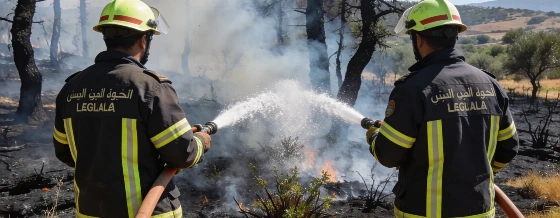
Algeria's civil protection teams are fighting 43 active wildfires across 14 wilayas, with Jijel, Béjaïa, and Tizi Ouzou among the hardest hit. The crisis highlights mounting pressure on vegetation and the need for rapid response as climate risks grow.
Algeria is facing a renewed wildfire emergency as civil protection units and supporting agencies continue to battle 43 active fires across 14 wilayas. As of Thursday at 13:00, authorities reported that 88 fire outbreaks had been recorded since the start of the latest wave, with 45 now fully contained. The most affected areas include Jijel, which leads with eight ongoing fires, followed by Béjaïa and Tizi Ouzou with five each. Annaba, El Tarf, Skikda, and Guelma each report four active fires, while Bouira, Mila, Tébessa, Sétif, Constantine, Souk Ahras, and M'Sila are also impacted.
In Jijel, wildfires are concentrated in the communes of Chekfa, Texenna, Ziama Mansouriah, Sidi Marouf, and Oulad Yahia Khedrouche, where emergency teams are working continuously to contain the flames. Béjaïa is seeing incidents in Tamridjet, Tichy, El Kseur, and Boukhelifa, while Tizi Ouzou's efforts are focused on Iflissen, Mizrana, Bounouh, Tigzirt, and Maâtkas.
Authorities Urge Immediate Evacuations in High-Risk Zones
With the situation deteriorating in several areas, the civil protection directorate in Jijel issued an urgent call on Thursday, 27 August, urging residents to avoid traveling to affected zones and to cooperate fully with emergency services. Those living near burning forests have been strongly advised to evacuate their homes voluntarily and preemptively, without waiting for official orders, to ensure personal safety and prevent loss of life.
Vegetation Under Strain as Fire Season Worsens
This surge in wildfires underscores the mounting pressure on Algeria's vegetation cover since the start of summer. Since 20 July, civil protection has recorded 1,460 fire outbreaks, while the Directorate General of Forests (DGF) estimates that over 1,666 hectares have been burned. Losses include 356 hectares of forest, 545 hectares of maquis, 661 hectares of scrubland, 14 hectares of alfa, and 89 hectares of fruit trees and mountain crops. These figures far exceed the 467 hectares lost during the same period in 2025.
For context, Algeria saw a total of 5,289 hectares burned in 2025-a nearly 90% reduction compared to the previous decade's annual average of 40,000 hectares. However, repeated heatwaves in 2026 have accelerated fire outbreaks and complicated containment efforts.
Expanded National Response and Early Detection Measures
In response to the escalating threat, Algeria launched its national wildfire prevention and response campaign on 1 May 2026, a month earlier than usual, extending operations through 30 November. The campaign is overseen by a 27-member national committee representing 14 ministries and 13 public institutions. This year's strategy includes the deployment of nearly 140 drones for early fire detection, supported by satellite imagery, geographic information systems, and real-time weather data. In May, the DGF also activated a national monitoring platform to centralize data and improve coordination of resources on the ground.
Despite these advances, the current crisis is testing the speed of detection, information flow, and the effectiveness of initial response-especially when multiple fires erupt simultaneously in neighboring wilayas. As operations continue, the top priority remains protecting populations and infrastructure, securing containment perimeters, and preventing flare-ups driven by wind and high temperatures.
Algeria's wildfire emergency echoes the broader regional challenge of managing climate-driven disasters. Similar to the urgent infrastructure response seen in Mauritania after a major substation fire, as reported in coverage of Mauritania's power restoration efforts, Algeria's experience highlights the need for rapid, coordinated action as climate risks intensify across North Africa.