
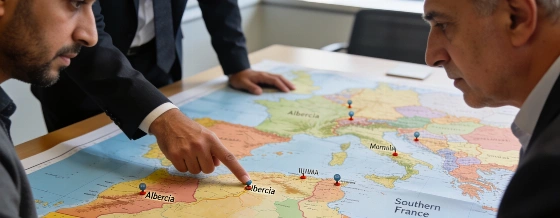
Russian outlet Rybar has published maps suggesting that, if Algeria were to acquire Russian Geran-5 drones, targets in Morocco and southern France could fall within range-adding a new angle to ongoing debates about regional security.
Rybar, a Russian media outlet known for its military coverage, has published maps exploring the idea of Russian-made Geran-5 drones being launched from Algeria. According to Rybar, these drones could theoretically reach high-value sites in Morocco and as far as southern France, including air bases, nuclear plants, and major industrial facilities.
On its Africa-focused channel on X, Rybar outlined the Geran-5's reported capabilities. The drone, which Russia has used in Ukraine since 2026, is said to have a range of up to 1,000 kilometers, though Rybar notes these figures are not independently confirmed. Open-source estimates, mainly from Ukrainian and specialist sources, put the Geran-5's speed at 450-600 km/h, its range at 950-1,000 km, and its warhead at about 90 kg. These details have not been verified by international monitors (INTELLINEWS). Rybar's maps highlight strategic infrastructure in Morocco and France that would be within reach if Algeria obtained the system.
Potential targets and scenarios
One of Rybar's maps revisits earlier claims about Moroccan infrastructure as possible targets. The more striking scenario is the suggestion that, if Algeria acquired Geran-5 drones, French sites in the south-including air bases, nuclear facilities, the Airbus plant in Toulouse, and oil infrastructure near Marseille-could be vulnerable to strikes from Algerian territory.
Rybar presents these scenarios as hypothetical, dependent on Algeria actually acquiring the Geran-5. There is no public evidence that Algeria has these drones. While some specialist outlets have speculated about their presence, Algerian authorities have not confirmed any such purchase. The Algerian Press Service (APS) and the Ministry of National Defence have not issued statements about buying or deploying Geran-5 systems, and recent security briefings in the region continue to note the lack of verified transfers (SiliconValley.ma).
Security implications for the region
These maps appear at a time when security ties between North Africa and Europe are under close review. The idea that drones based in Algeria could threaten strategic sites in Morocco and France adds a new complication to regional defense planning. This follows earlier concerns about the vulnerability of key infrastructure, including maritime routes (reported here). France has officially acknowledged the rise in "hybrid threats" from Russia. On September 18, 2026, President Emmanuel Macron directed the government to develop a national plan to protect critical infrastructure from drone and cyberattacks, a move widely reported by agencies such as Reuters and the Maghreb Arab Press (MAP).
Although there is no concrete evidence that Algeria has acquired the Geran-5, Rybar's scenario-building reflects the growing influence of long-range drones on military planning in the Maghreb and Europe. Even the suggestion of such capabilities-especially when mapped out in detail-can shape strategic thinking and diplomatic responses, regardless of whether the systems are actually in place. For now, the Geran-5 remains a hypothetical factor in Algeria's arsenal. Still, the public discussion of these scenarios shows how security calculations in the region are being shaped not only by weapons, but also by the narratives and perceptions that surround them. Regional outlets, including Tunis Afrique Presse (TAP), continue to follow these developments as North African countries consider the impact on their own defense and foreign policy.