
Morocco's electric vehicle market is growing fast, but drivers still struggle to find reliable charging. Startup Watt.ma is betting on smarter software to help close the gap as the government pushes for millions of EVs by 2035.
Morocco wants to see 2.5 million electric vehicles on its roads by 2035, but the country's charging network is struggling to keep up. The Moroccan Association for Automotive Industry and Trade (AIVAM) reports that electrified vehicles made up 17% of new passenger car sales by July 2026, with 22,963 units registered in the first seven months of the year-an 86% jump from the previous year, according to Le360 and the Ministry of Energy Transition and Sustainable Development. Still, drivers face a scattered and unreliable charging network. There are only about 150 public fast-charging stations across the country, far below the 1,500 fast-charging points that experts say are needed to support wider adoption.
Some in the industry claim there are 1,500 charging stations, but independent regional reviews, including those cited by The Eastleigh Voice, put the real number closer to 120-150 active public charging points. This leaves Morocco with a much lower network density than other leading African markets. The problem isn't just the number of stations-many are unreliable, with inconsistent service and unclear billing. The Ministry of Transport and Logistics has acknowledged that the charging network needs to be both larger and more dependable if Morocco's electric mobility plans are to succeed.
Watt.ma tries a software fix
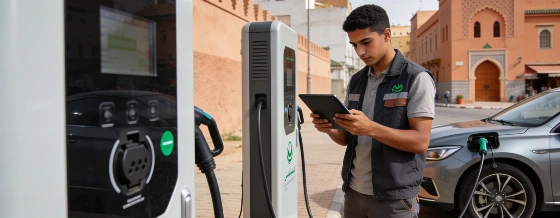
Electrical engineer Prince Marfo is tackling the reliability problem through his startup Watt.ma, a platform that manages and monitors charging stations in real time. The software lets operators and site owners control rates, track sessions, and handle billing remotely. For now, Watt.ma is focused on public charging stations; private use is still under review because of monetization issues. The company is working with the Institute for Research in Solar Energy and New Energies (IRESEN) and Mohammed VI Polytechnic University (UM6P) to align its technology with Morocco's decarbonization goals, as noted in recent statements from the Ministry of Energy Transition.
Marfo says the project has drawn strong interest, especially after its presentation on social media. The goal is to make managing charging stations easier, which could encourage more drivers to switch to electric vehicles. This fits with the government's broader push for innovation in the sector, as outlined in official releases from the Moroccan Press Agency (MAP).
Industry and government push for better infrastructure
Startups aren't the only ones working on the problem. Companies like Fastvolt, backed by Afrimobility, are building out fast-charging networks to meet rising demand. Morocco's auto industry is also shifting toward electrification, with plans to boost EV production and develop a local battery sector. OCP Green Energy, in partnership with Envision and UM6P, recently launched Morocco's first large-scale battery energy storage system in Benguerir-a 25 MW/125 MWh LFP installation that will help support future charging infrastructure according to Yabiladi. Still, Morocco wants to become a regional EV manufacturing hub while its own charging network is just getting started.
The government is trying to close the gap. Fully electric vehicles are exempt from vehicle tax, and customs duties on some imported EVs have dropped from 17.5% to 2.5% over the past decade. IRESEN is leading efforts to develop charging technology and support deployment projects. A World Bank report, backed by the Ministry of Industry and Trade, estimates that reaching the 2.5 million EV target by 2035 will require at least 25,000 charging stations-more than sixteen times the current number.
What's next as Morocco ramps up electrification
As Morocco's electric vehicle fleet grows, the need for a stronger charging network will only increase. Some projects show what's possible even in underserved areas. Stellantis, working with Solar Power, has launched a year-long pilot of an autonomous solar-powered EV charging station at Motor Village Bouskoura. The station can charge up to eight plug-in hybrids or three battery electric vehicles per day without a grid connection. It uses four AC ports (up to 19 kW each), battery storage, and two standard sockets for micromobility. A Fiat TRIS can charge from 20% to 80% in about four hours, according to Morocco World News and 7news Morocco. The results of this pilot will help decide if similar setups can be rolled out in remote and rural areas, a move closely watched by the Ministry of Energy Transition and Sustainable Development.
Morocco's electric mobility transition is at a turning point. Government incentives and new platforms like Watt.ma show a willingness to address the infrastructure gap, but the scale of the challenge is significant. Unless the country can quickly expand and professionalize its charging network, mass electrification will remain out of reach-and Morocco's hopes of leading in regional EV production could be limited by its own domestic constraints. For updates on national infrastructure policy, readers can check the official Moroccan government portal and follow communiqués from the Ministry of Energy Transition and Sustainable Development.