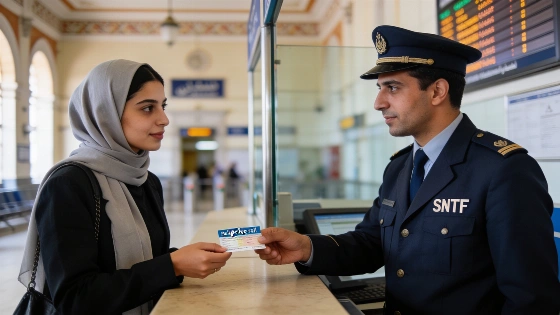
Algeria's SNTF has introduced a half price rail card, slashing ticket costs by 50 percent across its network and offering flexible subscription options. The move is designed to boost passenger numbers and strengthen regional rail connections, including the Annaba Tunis route.
Algeria's state rail operator SNTF has thrown down a challenge to the country's transport status quo, unveiling a half price rail card that instantly halves ticket costs for eligible passengers across its entire network. The move is not just a pricing tweak-it is a direct attempt to pull more Algerians onto trains and reshape the economics of national and cross border rail travel.
For the first time, SNTF's new "carte demi-tarif" offers a 50 percent discount on all domestic routes, with subscriptions available for three, six, or twelve months. Annual cardholders can even stagger payments in three instalments, a rare concession in Algeria's public sector. The card is available on request at SNTF's regional offices in Algiers, Oran, Constantine, and Annaba, and can be used to buy discounted tickets at station counters nationwide.
Discounts Reshape Access and Regional Mobility
The half price card is not just a consumer perk-it is a calculated intervention in Algeria's transport market. By lowering the cost barrier, SNTF is betting on a surge in ridership, especially among regular commuters and families. Children under four travel free, while those aged four to twelve receive the same 50 percent discount, further broadening the scheme's reach.
Operationally, the card's launch coincides with renewed attention to Algeria's international rail corridor. The Annaba Tunis line, a rare cross border passenger service in the Maghreb, now runs three times weekly in each direction. Trains depart Annaba on Sundays, Tuesdays, and Thursdays at 09:00, arriving in Tunis at 18:27, with stops at Souk Ahras, Ghardimaou, Jendouba, and Béja. The return leg leaves Tunis on Mondays, Wednesdays, and Fridays at 08:25, reaching Annaba at 18:20. Border formalities are handled at Souk Ahras (Algeria) and Ghardimaou (Tunisia), with tickets sold at Annaba, Souk Ahras, and major stations including Algiers, Oran, Constantine, Sétif, and El Eulma.
Pricing and Payment Flexibility Signal Competitive Shift
Ticket prices on the Annaba Tunis route are set at 1,900 DA for first class and 1,640 DA for second class, with round trips priced at 3,485 DA and 3,040 DA respectively. These rates, combined with the new half price card, represent a significant reduction in cross border travel costs-an explicit attempt to compete with road and informal transport options.
SNTF's willingness to offer multi-month subscriptions and payment in instalments marks a notable shift in Algeria's public transport sector, which has historically lagged behind in customer-centric innovation. The company's strategy echoes broader efforts to modernise and expand public mobility, as seen in other recent moves such as the fleet renewal in Jijel reported earlier.
Strategic Stakes and Author's Analysis
By slashing fares and introducing flexible payment, SNTF is not simply chasing higher passenger numbers-it is testing whether Algerian rail can reclaim relevance in a market dominated by private cars, buses, and informal taxis. The cross border Annaba Tunis service, in particular, stands as a rare example of Maghreb regional integration in practice, even as political and logistical barriers persist elsewhere. If SNTF's gamble pays off, the half price card could become a model for other state operators in the region, forcing a rethink of how public transport is priced and delivered. For now, the real test will be whether Algerians respond with their wallets-and whether the state is prepared to sustain these discounts if ridership does not immediately surge. The move is bold, overdue, and signals a rare willingness to disrupt entrenched habits in Algeria's transport sector.