
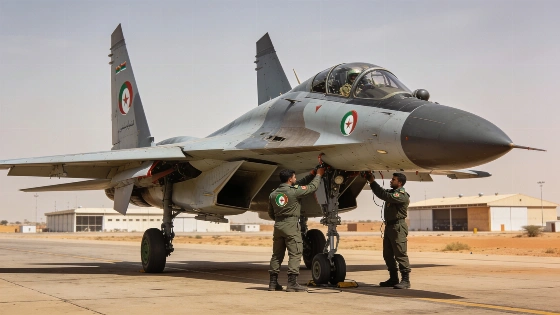
Algeria's unprecedented deployment of Su-30 jets to Niger marks a decisive shift in its security doctrine, linking military presence to energy investments and signaling that instability in the Sahel now falls within Algiers's strategic perimeter.
When four Algerian Su-30 fighter jets landed in Niamey on 30 August 2026, the message was unmistakable: Algeria now considers the chaos in Niger not just a neighbor's problem, but a direct threat to its own interests. This was not a symbolic flyover. It was the first time Algiers activated its constitutional power to send troops abroad, and it did so at the explicit request of Niger's government, just hours after mutinous soldiers stormed a military base and advanced on the presidential palace.
Yet the real story is not about the jets themselves. It is about what they are protecting-and what their arrival reveals about Algeria's evolving definition of national security.
Energy corridors and strategic leverage
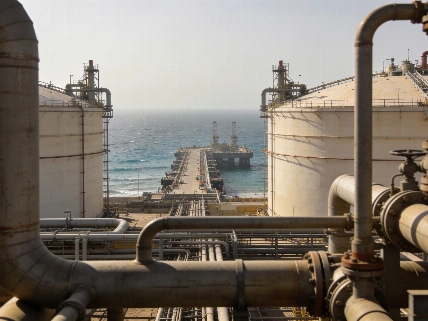
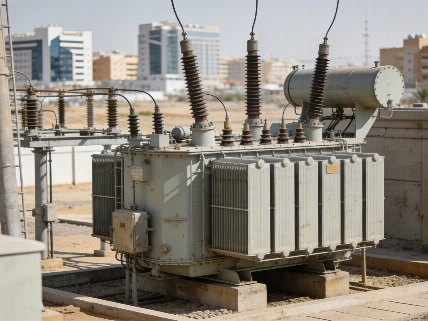
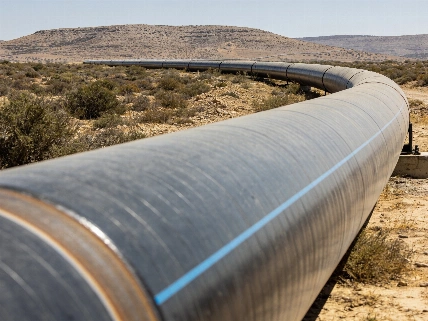
Months before the Su-30s appeared on Nigerien tarmac, Algeria had already embedded itself in Niger's energy infrastructure. In June, Algerian engineers completed a 40-megawatt power plant at Gorou Banda, on the outskirts of Niamey, in under three months. Subsidiaries of Sonatrach, Algeria's state energy giant, signed three deals with SONIDEP, Niger's national oil company, covering seismic surveys, drilling, fuel distribution, and training. The next day, Algeria broke ground on its section of the Trans-Saharan Gas Pipeline-a project designed to connect Nigeria's gas fields to Europe via Niger and Algeria.
By the time the jets arrived, Algiers had already staked its claim: electricity, oil, gas, and infrastructure now bind the two countries. The deployment was less a leap into the unknown than a calculated move to shield investments already made. In this context, military presence is not about conquest or regime change, but about securing the arteries of energy and influence that now run south from Algeria's border.
From non-intervention to flexible frontiers
For decades, Algeria's foreign policy was anchored in non-intervention-a doctrine forged in the crucible of its own war for independence. The collapse of Libya after 2011 only deepened Algiers's suspicion of foreign military adventures, even as terrorism and arms spilled across its borders. Officially, Algeria's support for the Polisario Front in Western Sahara was always framed as decolonisation, never as direct intervention. Uniformed troops stayed home.
That changed in 2020, when Algeria amended its constitution to allow troop deployments abroad, provided parliament approved. For years, this legal door remained closed. The Niger crisis forced it open. The Su-30 deployment is not a wholesale abandonment of caution, but a recalibration: Algiers now treats instability in the Sahel as an extension of its own security space, not a distant concern. The southern border is no longer a hard line-it is a frontier that can be pushed outward when strategic interests demand it.
This shift is not purely altruistic. After a 2025 incident in which Algeria shot down a Malian drone, relations with the Alliance of Sahel States soured, and ambassadors were withdrawn. Only in early 2026 did outreach resume. The current intervention is as much about repairing influence as it is about defending allies.
Deterrence by presence not by force
The Su-30s are not enough to tip the military balance in the Sahel. Their real value lies in the signal they send: Algeria will respond when instability threatens its investments or its borders. This is deterrence by presence, not by overwhelming force. While Russia's Africa Corps provided direct combat support to Niger's junta, Algeria's approach is different-offering proximity, reassurance, and a reminder that it is the region's immediate neighbor, not a distant patron.
Niger, for its part, remains a member of the Alliance of Sahel States, alongside Mali and Burkina Faso. Whether Algeria's support complements or competes with Russian backing is unresolved. What is clear is that Niger's options are narrowing as new dependencies-on Algerian energy, infrastructure, and now security-take root.
Strategic interdependence or new sphere of influence?
Algeria's model diverges from the old Sahelian reliance on external powers. It has not joined the Alliance of Sahel States, nor has it aligned with Moscow. Instead, Algiers positions itself as a North African bridge to the Sahel, offering energy, infrastructure, and selective security support without demanding bloc allegiance. This is the official narrative. The less charitable reading is that Algeria is building a web of dependence that limits Niger's autonomy as effectively as any formal alliance.
For Algeria, Niger is no longer just a neighbor-it is a corridor linking Algerian security, energy interests, and regional influence. Whether Niger experiences this as partnership or absorption remains an open question. What is certain is that external support, however robust, cannot substitute for Niger's own institutional cohesion or governance. Algerian assistance may buy time, but it does not resolve the underlying crisis.
Regional consequences and the new doctrine
Algeria's intervention signals a new doctrine: instability on its southern border is now a direct national security concern, justifying limited but decisive involvement. This is not a return to African interventionism, but a shift toward regional powers taking responsibility for their own deterrence. Egypt, Nigeria, Ethiopia, Kenya, and South Africa face similar dilemmas, but none has yet articulated the doctrine as explicitly as Algiers.
Four Su-30s did not change the military equation in the Sahel. But they did redraw Algeria's security map-and made clear that Algiers will now project power to protect its interests beyond its borders. The rhetoric of partnership cannot disguise the reality: Algeria is no longer content to watch instability from the sidelines. It is building a new perimeter, and the rest of the region will have to decide whether to adapt, resist, or compete for influence in this newly contested space.