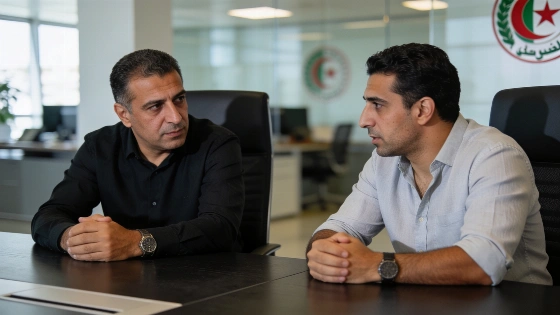
After months of failed foreign recruitment, Algeria's football federation is poised to name Brahim Hemdani as head coach, with Anthar Yahia as his deputy. The move signals a strategic shift toward local leadership and youth renewal ahead of key continental fixtures.
Algeria's search for a new national football coach is nearing its conclusion, and the outcome is a decisive break from months of fruitless international headhunting: Brahim Hemdani is now the frontrunner to take charge of the national team, with Anthar Yahia set to serve as his assistant. The Algerian Football Federation (FAF) is preparing to formalize the offer, ending a protracted saga that left the team's bench vacant since Vladimir Petkovic's departure.
This pivot comes after the federation's exhaustive but ultimately unsuccessful pursuit of foreign candidates. Over sixty international coaches submitted applications, but none matched Algeria's technical and financial requirements. Negotiations with high-profile names-including Gustavo Poyet-collapsed, and even a last-ditch attempt to secure a Portuguese coach failed when he could not exit his club contract. The federation's leadership, facing mounting pressure and a ticking clock ahead of the next competitive cycle, has now turned inward.
Why Hemdani and Yahia? Credentials and Federation Calculus
The decision to back Hemdani is rooted in two hard facts. First, his playing pedigree is unimpeachable: he captained both Marseille and Glasgow Rangers, and holds the UEFA Pro License, Europe's highest coaching qualification. Second, his recent success with Algeria's youth squad-clinching the Mediterranean tournament-demonstrated his ability to manage and motivate a group under pressure. For the FAF, these credentials outweighed the allure of a foreign name, especially after repeated disappointments on the international market.
Anthar Yahia's inclusion is no afterthought. His name circulated persistently after Algeria's World Cup elimination, and pairing him with Hemdani is a calculated move to blend technical expertise with institutional memory. The duo's appointment, however, is expected to be on a deliberately short-term basis, giving the federation flexibility as it assesses the team's direction ahead of the 2027 Africa Cup of Nations.
Strategic Shift: Local Leadership and Youth Renewal
With the foreign option exhausted, the FAF is already mapping out a new organizational structure for the coming cycle. The immediate priority: rejuvenating the squad. This means a renewed focus on promising talent from the domestic league and dual-nationality players who could be persuaded to join the Verts. The federation's leadership sees this as a window to rebuild, with only three training camps scheduled before the next continental tournament and a manageable competitive calendar through March.
The final green light now rests with the FAF's Bureau fédéral, which will meet on Saturday to validate the appointment. If Hemdani accepts the terms, the announcement will end a summer of uncertainty and speculation, finally providing clarity for supporters and players alike.
Algeria's decision to abandon the foreign coaching carousel in favor of homegrown leadership is less a gamble than a pragmatic response to repeated setbacks and shifting realities. The federation's inability to land a marquee international name exposed the limits of its negotiating power, but it also forced a reckoning with the country's own coaching resources. By betting on Hemdani and Yahia, the FAF is signaling a willingness to invest in local expertise and youth development-an approach that, if managed with discipline, could yield more sustainable results than another round of imported solutions. The real test will come not in the press conference, but on the pitch, where the federation's new strategy will face its first uncompromising verdict.