
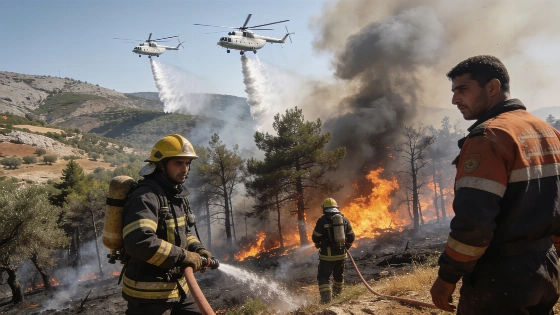
Three major wildfires continue to burn across Sétif, Béjaïa and Skikda, forcing Algerian authorities to deploy aerial firefighting assets and mobilise nationwide solidarity efforts as local communities face mounting losses and disruption.
Helicopters thundered over the forests of Sétif on Friday as Algerian emergency teams scrambled to contain three stubborn wildfires still raging across Sétif, Béjaïa and Skikda. Despite days of relentless ground operations, the fires have resisted full containment, threatening agricultural land, forests and the stability of rural communities.
With the situation escalating in the Charen Beyan forest near Rasfa, authorities deployed two Mi-26 water-bombing helicopters to strike at hotspots unreachable by ground crews. The urgency is clear: eight separate blazes erupted in recent hours, and while five have been subdued, the remaining three continue to test the limits of Algeria's civil protection forces.
Escalating Threats and Emergency Response
In Skikda, a fresh outbreak in Oum El Toub forced a rapid surge of firefighters and equipment, as teams raced to prevent the flames from advancing into populated areas. Meanwhile, Béjaïa's fire front remains active, with local units working around the clock to halt further destruction. The Directorate General of Civil Protection confirmed that as of 17:00, the fires in these three wilayas remained the top operational priority.
These wildfires are not isolated incidents. They come as part of a broader pattern of climate-driven risks and resource strain across North Africa, where drought and heatwaves have amplified the vulnerability of rural and forested regions. The stakes are not only environmental but economic, as agricultural yields and local livelihoods hang in the balance. The current crisis echoes the kind of systemic pressures highlighted in recent coverage of regional fiscal and resource shocks.
Solidarity Caravans and Community Support
Beyond the immediate firefighting, a parallel mobilisation is underway to support those displaced or affected by the fires. On Friday, a cultural and solidarity caravan departed from Béjaïa, targeting the hardest-hit villages such as Achlouf, Derguina, Tizi Ahmed Betichi and Melbou. This initiative, part of the national programme "Caravanes culturelles, main dans la main pour une Algérie unie" and led by the Ministry of Culture and Arts, brings together volunteers and artists from across the country to deliver workshops, distribute books and gifts, and create safe spaces for children traumatized by the disaster.
Local authorities are overseeing the week-long journey, which aims to restore a sense of normalcy and hope in communities battered by fire. Omar Regal, Béjaïa's Director of Culture and Arts, described the effort as a "message of love, solidarity and support" for residents, especially the youngest. The caravan's activities are designed not only to provide material relief but to help rebuild the social fabric strained by repeated emergencies.
What to Watch Next
With aerial and ground operations ongoing, the next 48 hours will be decisive for containment. The effectiveness of the Mi-26 helicopter sorties in Sétif and the rapid response in Skikda will determine whether authorities can prevent further escalation. Meanwhile, the resilience of local communities will depend on the sustained delivery of aid and the ability of national institutions to coordinate both emergency and recovery efforts.
Algeria's firefighting apparatus is under visible strain, and the country's response to these wildfires will serve as a test of its civil protection capacity in an era of intensifying climate risk. The real measure of success will not be in the number of hectares saved, but in the speed and integrity of support delivered to those on the front lines. As the flames continue to threaten lives and livelihoods, the gap between operational rhetoric and on-the-ground reality is where Algeria's institutional credibility will be judged.