
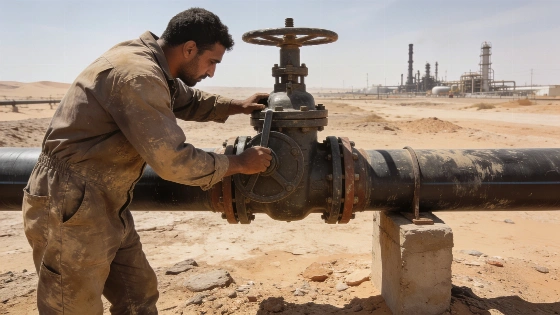
Libya's biggest oil field has slashed production after armed men closed a key pipeline valve. The move threatens crude exports and state income as oil prices surge. The National Oil Corporation warns it may declare force majeure if the shutdown drags on.
Libya's oil industry is facing another blow. An armed group suddenly closed a main pipeline valve from the El Sharara field, cutting output and putting exports in danger. The National Oil Corporation (NOC) confirmed late Monday that production at El Sharara, Libya's largest oil field, has already dropped sharply. This field is a major source of money for the state. According to a Reuters update, the incident happened on 21 September 2026. Armed men closed valve No. 7 on the Sharara-Zawiya pipeline. Output fell fast right after.
The risk is immediate. If the pipeline stays shut, the NOC says it may have to declare force majeure. That would let the company suspend contracts because of events it cannot control. The NOC did this before at El Sharara in January 2024, when another blockade stopped work. This warning comes as world oil prices have jumped above $100 a barrel, raising the stakes for Libya's weak economy. The Tunis Afrique Presse (TAP) agency points out that Libya's oil exports are crucial for energy stability in North Africa.
Pipeline closure hits El Sharara and Zawiya refinery
This pipeline runs from El Sharara, about 700 kilometers south of Tripoli, to Zawiya on the coast. Zawiya has one of Libya's main export terminals and a big refinery. The NOC has not named the group behind the latest closure. In Libya, militias and protesters often use pipeline blockades to push for political or economic demands. The NOC says closing the valve has caused pressure to build up in the pipeline and sharply cut output at El Sharara. The company also warns that the Zawiya refinery, about 45 kilometers west of Tripoli, could have to shut down if the problem is not fixed soon. That would hit state revenues even harder at a time when Libya's finances are already stretched. The Algerian Press Service (APS) has reported before on how cross-border energy infrastructure in the Maghreb is exposed to these kinds of risks.
Strategic asset under repeated threat
El Sharara is run by Akakus Oil Operations, a joint venture between the NOC and foreign partners: Spain's Repsol, France's TotalEnergies, Austria's OMV, and Norway's Equinor. At full speed, the field pumps about 350,000 barrels a day. That's around a third of Libya's total oil output. Its size and importance have made it a regular target for blockades and shutdowns. The field was closed for two years between November 2014 and December 2016, and there have been more stoppages since the fall of Muammar Gaddafi in 2011. The NOC says the current shutdown is costing about 130,000 barrels a day. Field engineers quoted by Reuters and Arab News say the drop could be as much as 200,000 barrels daily, leaving only 100,000 to 105,000 barrels coming out each day.
Libya's energy system is still wide open to armed interference. The country is split between the UN-backed government in Tripoli, led by Prime Minister Abdulhamid Dbeibah, and a rival group in the east supported by General Khalifa Haftar. This split leaves key sites like El Sharara exposed to local power plays and armed pressure. The African Union's Peace and Security Council has called again and again for better protection of energy infrastructure in the region, naming Libya as a top case for joint security work.
These shutdowns are not rare. As reported earlier, past blockades at Zawiya have already put refinery operations at risk and forced the NOC to consider force majeure. This shows how often Libya's oil sector faces sudden threats. The Moroccan news agency MAP says regional energy ministers have talked about backup plans for supply shocks at recent Maghreb Union meetings. There is growing worry about how often these incidents happen.
Revenue at risk as global prices climb
This shutdown comes at a bad time for Libya's budget. Oil prices are rising because of wider trouble in Gulf shipping linked to the Iran war. Any long loss of production from El Sharara will cut state income right away. The NOC's statement is blunt: Libya's ability to export oil and keep refineries running is now at risk. The Ministry of Oil and Gas of Libya says it is working to restore normal operations and is in touch with international partners, as shown in a recent official communique.
Libya's huge oil wealth is still at the mercy of armed groups and political splits. Until the state can protect its key assets and bring stable rule, the oil sector will stay on edge-open to sudden shocks that hit both the economy and the wider region.