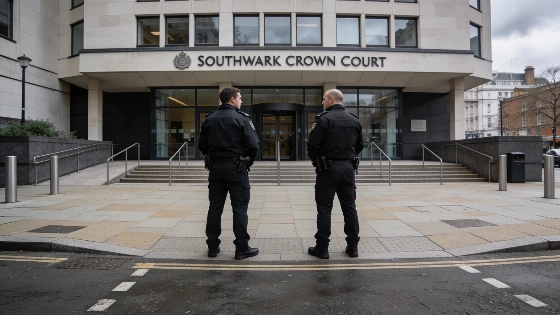
A London court has sentenced British arms broker David Greenhalgh and his Greek partner Christos Farmakis to 16 years in prison for running illegal deals that sent missiles, fighter jets, and other weapons to embargoed countries like Libya and Sudan. The case lays bare how arms traffickers work around global controls.
David Greenhalgh and Christos Farmakis are now facing 16 years behind bars. A London court found them guilty of running a large arms trafficking ring that sent weapons to some of the world's most unstable, embargoed countries. The sentencing came down on 23 September 2026 at Southwark Crown Court. The verdict, reached in June, was covered by international and regional outlets, including the Maghreb Arab Press (MAP) and Algeria Press Service (APS). The case drew attention across North Africa and the wider MENA region.
Southwark Crown Court's decision is a rare win against international arms brokers who have long slipped through regulatory cracks. Greenhalgh, a British citizen from Croydon, and Farmakis, a Greek national tried in absentia, were found guilty on several counts under the UK's Export Control Order 2008. The trial lasted nine weeks and exposed how their operation worked. HM Revenue & Customs said Greenhalgh was convicted on ten counts, Farmakis on nine. The numbers show just how far their network reached.
How the trafficking network worked
From July 2009 to December 2016, Greenhalgh and Farmakis tried to broker deals for a long list of weapons: surface-to-air missile systems, fighter jets, combat helicopters, tanks, anti-tank weapons, assault rifles, and ammunition. They sourced these from former Soviet and Eastern European suppliers. The weapons were headed for embargoed conflict zones-Sudan, South Sudan, Libya, Iraq, and Iran. Libya has been under a UN arms embargo since 2011. The United Nations Security Council keeps renewing it, and regional authorities like Tunis Afrique Presse (TAP) and the Libyan Ministry of Foreign Affairs keep watch.
Prosecutors showed that one deal went through: a Ukrainian S-125 Pechora surface-to-air missile system ended up in South Sudan. Other deals never made it past the planning stage. But the pattern was clear. The traffickers used companies in third countries, fake end-user certificates, and doctored shipping papers to dodge export controls and hide the real buyers. The steady flow of illegal arms into Libya and Sudan has worried the African Union Peace and Security Council for years. The council keeps calling for tighter border checks and more regional cooperation to stop these shipments.
Farmakis, convicted on nine counts, was not in court. Greenhalgh faced ten counts. Their operation stood out for its reach and its use of legal loopholes. They took advantage of weak cross-border oversight. A recent MAP communique said Morocco and other Maghreb countries are stepping up their work in multilateral arms control efforts. They want to make embargo rules stronger and share information faster across the region.
Enforcement gaps and the official response
The case came together thanks to joint work by HM Revenue and Customs investigators and the Crown Prosecution Service. Their investigation exposed not just the men involved, but also the weak spots in global arms control. The prosecution showed how important it is for criminal investigators and export-control officials to work closely, especially as traffickers use more complex international setups to hide what they do. Regional agencies like the Algerian Ministry of Foreign Affairs have raised the same concerns. APS has reported on calls for joint monitoring and faster information sharing.
For the UK, these 16-year sentences are unusual. It is rare for arms brokers to be held to account for trying to send or actually sending military gear to embargoed countries. The link between the defendants and the attempted supply of fighter jets, helicopters, armored vehicles, small arms, and air-defense systems could set a new standard for future cases. In the Maghreb, officials are watching closely. Illegal arms flows have long fueled unrest and made peace harder, especially in Libya and the Sahel.
But the case also shows the ongoing problem. As long as there is demand in embargoed countries and loopholes in the rules, arms traffickers will keep finding ways around the system. Prosecuting Greenhalgh and Farmakis is a big step, but the system that lets these deals happen is still only partly controlled. Policymakers and enforcement agencies face a clear lesson: without constant vigilance and international teamwork, illegal arms trading will keep threatening regional security and undermining embargoes. The United Nations Economic Commission for Africa (UNECA) has recently stressed the need to align national export controls and build stronger regional laws to close these gaps.