The US is training personnel from Libya's rival military structures and pushing for closer cooperation. Russia is upgrading six air bases that extend its access across Libya and toward the Sahel.
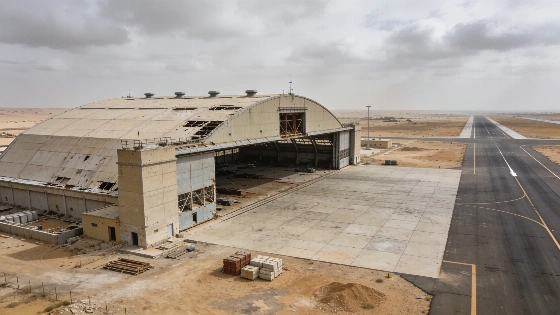
Satellite imagery has documented construction and renovation at six Libyan air bases linked to Africa Corps activity. Washington is taking a different route, working to connect the country's eastern and western military structures.
The competition does not divide neatly into a US-backed west and a Russian-backed east. Washington is building cooperation across the divide. Moscow is expanding access to airfields, while also strengthening links for personnel and logistics.
After Khalifa Haftar's 2019-20 offensive failed, Libya's rival sides agreed to a UN-brokered ceasefire in October 2020. The Center for European Policy Analysis, or CEPA, says Moscow later used Libya to support Haftar's forces. It also became a transit hub for personnel moving toward Central Africa and the Sahel. Russia's presence began with the Wagner Group. After Yevgeny Prigozhin died in 2023, the Russian Defence Ministry-controlled Africa Corps became more prominent.
Russia's network stretches east and south.
The US National Geospatial-Intelligence Agency's Tearline project identified Russia- or Africa Corps-linked activity at six sites: Al-Khadim and Al-Jufra; Tamanhint and Matan al-Sarra; Al-Qardabiyah and Brak al-Shati. Since 2024, imagery has shown construction on hangars and barracks. It has also documented work on warehouses and technical facilities. Parking areas and runways have seen changes too.
The sites span eastern Libya. Others lie in the country's central and southern regions, connecting Libya to routes toward the Central African Republic and Mali. Other routes lead toward Burkina Faso and Niger.
Al-Khadim is described as a transit point between Libya and the Sahel. Matan al-Sarra extends Russian access into the Sahara, near Chad and Sudan. The Washington Institute for Near East Policy has reported that the airfields may host air-defence radars. Its reporting also cited MiG-29 fighters and drones operated by Russian personnel, including Africa Corps members. The institute estimates the Russian contingent at no fewer than 1,800 military personnel and Africa Corps members. CEPA puts the figure at about 2,000.
These remain Libyan military installations, not bases formally transferred to Russia. Reporting on the imagery describes Russian access to parts of the facilities. It also points to access for personnel and logistical support, chiefly in areas linked to Haftar's forces. Russia has not publicly confirmed that it has established its own bases.
CEPA reported that two Russian merchant vessels arrived in Tobruk in September 2025. A naval transport arrived as well, unloading armoured vehicles and trucks. The port links sea deliveries with airfields. Supplies can then move overland through eastern and southern Libya. An earlier report detailed Russian military deliveries to Tobruk.
The Washington Institute has linked Moscow's growing military access to closer ties with Haftar's family. It reported that Khaled Haftar, Khalifa Haftar's son and a senior commander, signed an agreement in Moscow to develop a strategic partnership. The agreement calls for expanded military and security cooperation.
Washington is working across the divide.
US engagement has included military cooperation with both sides of Libya's split. Phoenix Express, a 12-day exercise involving 13 countries, focused on maritime security in the southern Mediterranean. Crews practised visiting vessels and boarding them. They also trained to search ships and seize them. US Force Reconnaissance Marines trained alongside personnel from Tripoli in Bizerte. The exercise was not framed as a campaign against one specific common enemy.
In April 2026, Libya, Italy and the United States jointly organised part of Flintlock 2026 in Sirte. The exercise brought together Libyan joint forces and international partners. AFRICOM said it supported the development of a more unified Libyan military.
In August, security leaders from eastern and western Libya travelled together to Ramstein Air Base. The US Air Force presented C-130J operations and maintenance. It also covered air mobility planning and the structures needed for an integrated air command.
Washington has not chosen Tripoli over Haftar. Its approach aims to connect military structures on both sides and build cooperation with Western partners. CEPA, by contrast, describes Libya as a staging point for Russian forces moving through to Central African states and the Sahel.
Haftar's forces remain closely tied to Moscow and control territory that hosts much of Russia's military infrastructure. Contacts with Washington have continued. In August 2026, those forces played an important role in the release of American hostage Kevin Rideout. Reuters also reported that Haftar's forces had acquired Chinese and Turkish combat drones despite the UN arms embargo.