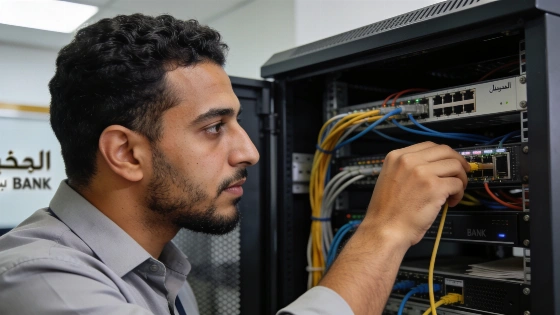
Libya recorded LD 765 billion in e-payment transactions from January to August 2026. Under CBL Circular 18/2026, banks and payment firms must tailor security controls to their risk profiles.
More than 4.29 million people use mobile banking in Libya. CBL Circular 18/2026 is now in effect, requiring banks and e-payment companies to set security controls beyond the baseline according to their risk profiles.
Payment volumes are climbing fast. Libya recorded LD 765 billion in e-payment transactions from January to August 2026; separate reporting put the total at LD 764.9 billion. By the end of September, electronic transactions had approached LD 865 billion, according to Libya Observer, citing CBL Governor Issa Mohammed Naji. An October report said e-payment services had exceeded LD 900 billion during 2026.
The CBL governor expects e-payment transactions to top LD 1 trillion by the end of 2026. The central bank introduced the security baseline after a Criminal Investigation Agency report on rising electronic fraud.
The circular leaves banks and payment firms to work out what additional controls their own risks require.
On 17 June 2026, Prime Minister Abdul Hamid Dbeibeh announced that electronic payments would become an official way to collect government fees and payments. He made the announcement while opening the Libya International Exhibition for Electronic Payment and Digital Transformation, EPIX 2026, in Tripoli. The Libya News Agency reported that Dbeibeh called digital transformation and e-payments a foundation for improving the efficiency and transparency of public institutions.
The CBL also announced that international Visa cards could be used in foreign currency through local terminals. It presented SoftPOS, which lets NFC-compatible smartphones act as payment acceptance points. Both developments were reported by the Libya News Agency.
While Libya's maritime dispute coverage concerns external relations, Circular 18/2026 focuses on the security of domestic financial services. Banks and e-payment companies must decide what extra controls fit their risk profiles.
A Group-IB white paper lays out the circular's 10 control domains and 48 requirements. It maps them to Group-IB's Fraud Protection platform and Cybersecurity Services. The guide separates the bank's responsibilities from Group-IB's, while also identifying duties for the bank's EFMS.
The white paper discusses session-level detection alongside behavioral biometrics. It also covers device intelligence in the context of fraud prevention. For cybersecurity testing, it maps Penetration Testing to the circular's requirements. Incident Response and Incident Response Readiness Assessment are linked to incident management. The paper identifies these capabilities, but does not enumerate the circular's individual controls.
The CBL's wider oversight work includes efforts to strengthen anti-money-laundering and counterterrorism-financing controls. At a meeting with US Federal Reserve representatives, the central bank discussed its work with K2 Integrity on transaction checks and audits. The talks also covered identifying suspicious requests linked to letters of credit, along with plans to expand a review team involving domestic and international organizations. The meeting addressed the integration of Libyan banks into the global financial system, according to Libya Observer.
In October 2026, prosecutors investigated the alleged misappropriation of LD 13 million at North Africa Bank. Libya Herald reported that suspects, including bank management, were remanded in custody pending the investigation. The allegations involved forged cheques. Investigators also examined foreign-currency transfers to cards for personal use despite insufficient account balances. The reported conduct included repeatedly discounting cheques that had already been processed.
The CBL and the International Monetary Fund agreed in December 2025 to cooperate on banking-sector development and payment-system modernisation. Their programme also covers financial inclusion. The agreement includes work on monetary-policy tools and banking supervision.
Sherif Rihan, Solution Manager, Group-IB META, said: "The security infrastructure needs to match it."