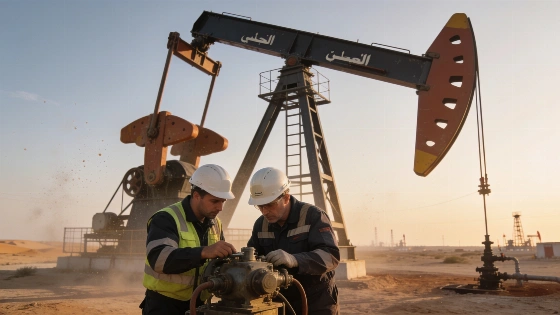
Chevron's re-entry into Libya signals a renewed push to revive the country's oil sector, but the scale of future production gains will depend on whether political and security risks can be contained long enough to attract sustained international investment.
Chevron is back in Libya, joining a new wave of international oil companies looking for opportunities in a country that has struggled to turn its large reserves into steady production since 2011. The Houston-based company secured an exploration and production-sharing agreement for Block S4 (Area 106) in the Sirte Basin, covering 7,437 square kilometres. This follows Libya's first licensing round in 17 years, according to the National Oil Corporation (NOC) and regional reports from Reuters. The renewed interest comes as instability elsewhere in the Gulf has made North African oil more attractive, with Algeria and Tunisia also working to strengthen their energy sectors, as reported by the Algerian Press Service and Tunisia's TAP news agency.
But signing deals is only the first step. Libya's real challenge is turning agreements into higher oil output. The NOC, led by Chairman Masoud Suleiman, wants to raise crude production from the current 1.4-1.5 million to 2 million barrels per day. Reaching that goal will take more than new exploration. It requires major investment in old fields, new drilling, and upgrades to infrastructure-none of which will happen without a stable political environment. Libya's acting Minister of Oil and Gas, Khalifa Abdussadek, has said the country needs $3-4 billion in new investment to reach 1.6 million barrels per day, a figure also mentioned by the African Union's North Africa Regional Office.
Chevron's new terms and the competitive landscape
Chevron's latest deal is different from its earlier experience in Libya. The company first entered in 2004 but left in 2010 after unsuccessful drilling. Now, Chevron returns under terms that reflect the NOC's push to attract capital. Chevron will cover all exploration costs for S4 and, if commercial resources are found, will receive a 25% share of oil profits. This is a better deal than previous contracts, where international companies sometimes received as little as 12% despite taking on all the risk. The production-sharing contract was finalized after Chevron was selected as the winning bidder in February 2026, according to sector data from Welligence.
Libya is also working with other international companies. Eni and QatarEnergy have secured offshore exploration rights in the same round. Repsol, MOL, TPAO, and TotalEnergies are expanding their involvement. TotalEnergies, for example, has extended its Waha concessions until 2050. The Ministry of Oil and Gas has highlighted the importance of these partnerships in recent official statements, pointing to the role of international expertise in reviving Libya's oil sector.
Production realities and the stability dilemma
Libya has Africa's largest proven oil reserves, but most of its current output comes from mature fields like Sharara and El Feel, which together produce over 400,000 barrels per day. These fields, developed decades ago, are still the backbone of production. Any new discoveries in Chevron's S4 block will take years to develop before they can affect national output. Recent disruptions, such as the closure of the Hamada-Zawiya pipeline valve that stopped production at Hamada (NC8), Tahara (NC4), and NC5, have shown how vulnerable the sector is to local unrest and the risk of force majeure, as reported by Reuters and the Maghreb Arab Press.
For now, the NOC's goal of 2 million barrels per day depends on getting more from existing fields. That means drilling new wells and modernizing infrastructure that has suffered from years of underinvestment and conflict. Whether these investments happen depends on the government's ability to provide a stable environment. As reported earlier, Libya has also reached out to Russian firms, showing how widely it is searching for capital and expertise.
Investment climate and the road ahead
Oil revenues are central to Libya's economy, and both the government and international investors have a lot at stake. Chevron's return and the interest from other companies show confidence in Libya's resources, but investors are still cautious. Political divisions and security risks have derailed previous efforts to revive the sector. Contracts like Chevron's S4 agreement will only lead to higher production and government revenue if Libya can offer the predictability investors need. The United Nations Economic Commission for Africa has repeatedly stressed that regional stability and transparent governance are essential for sustainable energy development in North Africa.
Libya's oil sector is at a turning point. The technical expertise and capital are available, but whether this new round of international involvement leads to lasting gains depends on the country's ability to stabilize its political environment. For now, the outcome remains uncertain.