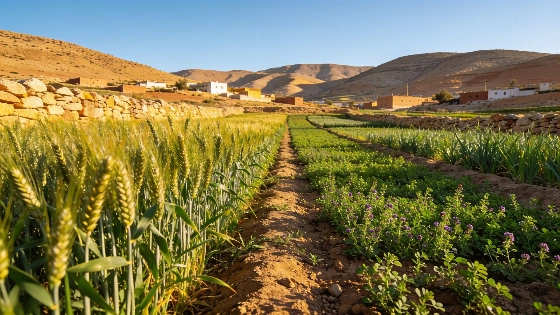
The three-year Citi Foundation-funded programme trained 1,042 unemployed young people and paired local market updates with business courses, while an evaluation tracked 798 rural households in Morocco and Tunisia.
In Tunisia, Sammifna's digital market service reached 68 per cent of households in participating communities. It gave growers local price and demand information alongside weather updates, with data covering wheat and barley, as well as lentils.
The three-year project, wrapped up by the International Center for Agricultural Research in the Dry Areas (ICARDA), focused on rural communities in Azilal province in Morocco's Béni Mellal-Khénifra region and El Kef governorate in Tunisia. Launched in November 2023, it combined digital market information with agricultural research and business training. ICARDA was selected as one of 50 recipients of the Citi Foundation's inaugural Global Innovation Challenge.
Market information for growers
The application tracked wheat and barley, with lentils also covered. Market updates went out in 11 weekly rounds from February to June 2026; weather data was refreshed every three hours throughout the project. Growers could use the information when making decisions about sales, planting and harvesting, or storage. ICARDA's project reporting describes the digital information and entrepreneurship components implemented across the two countries.
Implementation partners included Morocco's Institut National de la Recherche Agronomique (Inra-Maroc) and the Béni Mellal-Khénifra Regional Council. Tunisia's partners were the Institut National de la Recherche Agronomique de Tunisie (Inrat) and the Institution de la Recherche et de l'Enseignement Supérieur Agricoles (Iresa).
Business courses and local interests
Sammifna trained 1,042 unemployed young women and men: 455 in Morocco and 587 in Tunisia. Four modules covered collective marketing, farm business models, agricultural start-ups and financial management. The materials were adapted to local conditions and offered in Arabic and French.
Tunisian participants expressed interest in livestock businesses and agricultural processing. They also identified value-added products, including olive oil, milk and honey, as well as natural cosmetics. A separate digital initiative in Morocco involved an Agadir student-built prototype; Sammifna focused instead on agricultural markets and rural business training.
Evaluation and project resources
The impact evaluation followed 798 rural households through surveys in 2025 and 2026, examining welfare and food consumption alongside financial inclusion, marketing practices and access to market information. In Tunisia, it identified a reduction in the share of household expenditure allocated to food. The evaluation also highlighted connectivity and functioning markets, along with infrastructure and opportunities for growers to sell surplus produce.
The project produced a digital market information application, four training curricula, market monitoring datasets, household survey data and impact assessments. Its work addressed information gaps affecting growers' decisions on production and selling, as well as storage and investment, alongside business skills and agricultural research.
"While access to information can create opportunities, it must go hand in hand with farmers' capacity to participate in commercial activities, supported by connectivity and market access," said Dr. Girma T. Kassie, Sammifna principal investigator and ICARDA's principal agricultural market economist.