
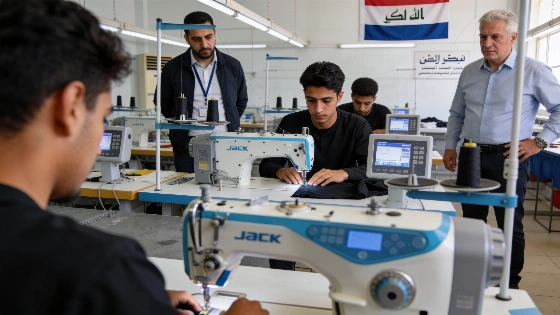
Egypt has joined the EU-backed AlignVET project, aiming to redesign technical and vocational education by embedding industry requirements into curricula. The initiative targets the ready-made garments and home textiles sector, with manufacturers shaping training to match real factory needs.
Egypt's technical education system is set for a fundamental reset as the AlignVET project, funded by the European Union's Erasmus+ programme, moves to embed industry-defined skills directly into vocational curricula. The Ready-Made Garments and Home Textiles Chamber at the Federation of Egyptian Industries (FEI) is now at the centre of this overhaul, with its representatives actively shaping the future of workforce training.
For the first time, Egyptian manufacturers are not just being consulted-they are driving the process of curriculum design. Mohamed Abdel Salam, Chairperson of the Ready-Made Garments and Home Textiles Chamber, made clear that only those running factories can accurately define the skills and competencies needed on the production floor. The sector's rapid technological shifts and evolving quality standards have left traditional education models trailing behind, with graduates often unprepared for real jobs.
Industry sets the agenda for skills and jobs
At recent workshops in Sweden, Egyptian industrial leaders joined European partners to identify the precise jobs, skills and competencies required by the ready-made garments and home textiles sector. The AlignVET project's core mechanism is simple: manufacturers articulate their needs, and educators translate these into concrete training programmes. The first sector-specific curriculum is scheduled for completion by June 2027, following extensive consultation with industry stakeholders.
Jan Henry Hanna, Acting President of Beni Suef Technological University, confirmed that the new curricula will incorporate advanced skills such as artificial intelligence, data analysis and modern production technologies-areas previously absent from most vocational programmes. The National Authority for Quality Assurance and Accreditation of Education (NAQAAE), led by Alaa Ashmawy, will ensure that all new content meets both international standards and Egypt's National Qualifications Framework.
EU funding and international expertise reshape Egyptian training
AlignVET is not a closed national project. Backed by EU funding and expertise from Swedish universities and technological institutions, the initiative aims to bridge the persistent gap between what employers need and what graduates can actually do. Ahmed Saeed Swelam, Director of the Educational Excellence Centre at Ain Shams University, stressed that sustainable partnerships between technical education providers and manufacturers are now non-negotiable if Egypt wants to compete globally.
The project's structure connects educational institutions, practical training providers and employers in a single feedback loop. This model is designed to be sustainable, ensuring that as industry requirements evolve, so too will the training delivered to students. The garments and textiles sector, a major employer and export driver for Egypt, stands to benefit directly from a workforce that is finally trained for the realities of modern production.
Egypt's move to put industry in the driver's seat of technical education is overdue. For years, the disconnect between classroom theory and factory practice has undermined both competitiveness and export potential. If AlignVET delivers on its promise, Egypt could set a new regional benchmark for aligning education with economic need-provided that manufacturers remain at the heart of the process and that curriculum reform is not derailed by bureaucratic inertia or shifting political priorities.
Further details on the project's progress and its impact on Egypt's industrial workforce can be found in the original Dailynewsegypt report.