
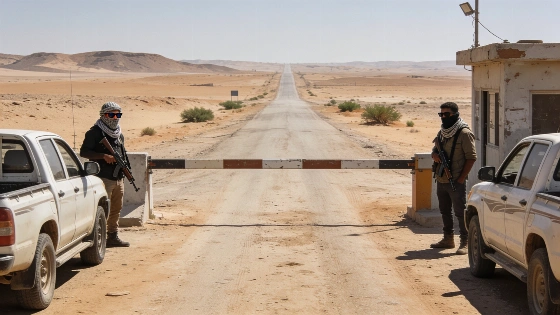
The Fezzan Revolutionary Force has sealed Libya's southern border to all truck and commercial traffic, declaring a closed military zone in response to the siege of Qatrun by Libyan National Army-aligned forces. The move disrupts trade routes to Chad and Niger and intensifies the power struggle in southern Libya.
Trade through Libya's southern border has come to a sudden stop. The Fezzan Revolutionary Force, a group closely tied to the Tebu community, has shut all southern crossings to trucks and commercial vehicles, declaring the area a closed military zone. The announcement, made on 12 September, follows the ongoing siege of Qatrun by forces loyal to the Libyan National Army (LNA) and Saddam Hafter. Independent English-language reports confirmed the closure on 13 September, noting the group's intention to halt all commercial movement until further notice. Regional security analysts and the Algerian Press Service (APS) are tracking the situation closely.
Qatrun sits over 1,000 kilometers south of Tripoli and is a key stop on the route to Chad and Niger. Now, it is at the center of a tense standoff. The Fezzan Revolutionary Force accuses LNA-aligned units of blocking fuel and cooking gas deliveries to Qatrun, saying these tactics are meant to break local resistance and curb smuggling of Libya's subsidized goods across the border. According to the Algerian Press Service, the closure has already disrupted trade, with effects reaching southern Algeria and Niger, where cross-border commerce is essential for isolated communities.
Border lockdown and threats against smugglers
The group's statement is blunt: all truck and commercial transport is banned, and the border region is now a military zone. Merchants and drivers are told to stay away or face the consequences. The Fezzan Revolutionary Force specifically targets those smuggling subsidized goods and fuel, threatening to destroy vehicles and cargo if caught. Anyone who ignores the order is considered a target. This move comes as Libyan authorities step up efforts against fuel smuggling, a problem highlighted in recent statements from the Ministry of Interior and covered by Tunis Afrique Presse (TAP).
Qatrun's communications have been cut. Both Al-Madar and Libyana mobile networks are down, and Starlink internet is reportedly jammed. Sources blame LNA technical interference for the blackout, which has left the town even more isolated. The United Nations Economic Commission for Africa (UNECA) has warned that such disruptions can have serious humanitarian and economic impacts, especially in border areas that rely on trade and aid.
Power struggle and the Qatrun flashpoint
This crisis began with a deadly shooting on 3 September, when a Tebu teenager, Hussein Youssif Ibrahim, was killed at a Qatrun fuel station by the LNA's Rapid Intervention Battalion (RIB-87), a unit linked to Saddam Hafter. The killing led to armed reprisals from local families, more casualties, and a partial LNA withdrawal. Tebu elders managed a brief pause in the violence, but new LNA military police and house raids ordered by Saddam Hafter soon reignited tensions. At least 23 Tebu residents, including local intelligence chief General Mahmoud Ibrahim, were detained-some reportedly for reporting events to Khalid Hafter instead of Saddam. These events have been confirmed by independent security reports and are being watched by regional observers, including Morocco's MAP news agency, which has noted the rising risk of ethnic and tribal conflict in southern Libya.
The episode has exposed a growing rivalry between Saddam and Khalid Hafter, both seeking influence in the south and within the Hafter family's power structure. Khalid briefly ordered a withdrawal from Qatrun, leaving only internal security units, but Saddam soon reversed this with a renewed crackdown. The result is a fractured command and a region slipping further out of central control.
Regional consequences and the limits of control
The Fezzan Revolutionary Force's border closure disrupts a major trade and smuggling route linking Libya to Chad and Niger. Its threats against smugglers and claim to military control challenge both the LNA's authority and the illicit trade networks that have grown amid Libya's political divisions. Still, no single group has ever fully controlled Libya's southern borders, and the blockade's effectiveness will depend on the group's ability to enforce its orders. The African Union's Peace and Security Council has noted that the Sahel's porous borders continue to undermine regional stability and complicate efforts to stop trafficking and armed groups.
Meanwhile, the Southern Liberation Operations Room (SLOR), another Tebu and Niger-based armed group, has called for armed resistance against "Hafter's gangs" and condemned ongoing killings and arrests. The SLOR's demands for a full LNA withdrawal from Fezzan and its criticism of fuel smuggling highlight the region's mix of local grievances, ethnic politics, and national power struggles.
The standoff in Qatrun is more than a border dispute. It reflects Libya's unresolved civil conflict, where local groups and rival commanders use the country's weak institutions to carve out their own zones of influence. The Fezzan Revolutionary Force's move to close the border is both an attempt to protect its community and a calculated step in the wider contest for southern Libya. The LNA's tactics and the Hafter family's internal rivalries have deepened the chaos, leaving residents to deal with siege, isolation, and economic hardship. Until southern Libya's power brokers reach an agreement-or are forced to by events on the ground-Fezzan will remain contested, with ordinary people bearing the cost.