
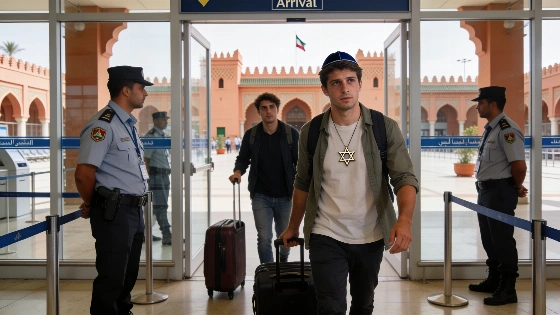
Direct flights between Israel and Morocco have restarted after a three-year halt, drawing Israeli tourists back to key cities and heritage sites even as a Level 3 travel advisory remains in place.
Travel between Israel and Morocco is picking up again after Arkia Israel Airlines restarted direct flights to Marrakech in August 2026, ending a nearly three-year pause. Moroccan news agency MAP reports that Israeli carriers now run three direct flights a week between Tel Aviv and Marrakech (Yabiladi). Even with Israel's National Security Council maintaining a Level 3 travel advisory, Israeli tourists are returning to Morocco's main cities, with many focusing on Jewish heritage tours.
Before flights stopped in October 2023, Morocco saw up to 200,000 Israeli visitors each year, according to the Moroccan Tourism Ministry. The current recovery is slower, with MAP and the Ministry of Tourism estimating up to 20,000 Israeli tourists by the end of 2026. Arkia is flying twice a week for now, and Israir and Sun D'Or plan to join after the holiday season. Sun d'Or, part of El Al, aims to start Tel Aviv-Marrakech flights on November 16, 2026, pending final approval from Moroccan and Israeli aviation authorities, as reported by Globes and confirmed by the Moroccan Directorate of Civil Aviation. El Al itself has not yet announced its own return, so the sector's recovery is happening in stages (JNS).
Heritage tourism leads the way
Organized tours are driving the rebound, especially among Israelis of Moroccan descent-estimated at up to a million people. But interest goes beyond those with family ties. Jewish heritage sites in Marrakech, Fez, Rabat, and Casablanca are attracting visitors interested in synagogues, cemeteries, and kosher restaurants, many of which have become easier to access in recent years. The Moroccan Ministry of Culture, Youth and Communication has supported restoration work in the Mellah quarters of major cities, helping preserve Jewish landmarks and improve the visitor experience, according to recent ministry statements.
Tour guides like Jamal Benkirane in Marrakech say Israeli groups are returning, drawn to the city's Mellah Jewish quarter, the Slat Al Azama Synagogue, and the Miaâra Jewish cemetery. Fez, known for its connections to Maimonides and Isaac Alfasi, and Casablanca, home to the largest Jewish community in the Arab world, are also popular stops. Kosher food and religious services are now easier to find, with the Moroccan Association of Jewish Communities reporting that the number of kosher-certified establishments has doubled since 2022. This reflects both government and private investment in religious tourism infrastructure.
Security and practicalities
The Israeli government's Level 3 advisory urges caution in Morocco's north and center and recommends avoiding non-essential travel to the south. Travel industry leaders say the main tourist routes remain manageable, and local authorities are focused on visitor safety. The Moroccan General Directorate for National Security (DGSN) has increased patrols and works closely with tourism operators in major cities, according to MAP. Still, Feldman of Ziontours describes his approach as "cautious optimism"-Moroccan partners are welcoming, but recent anti-Israel protests have made him more careful in promoting the destination.
Travelers are advised to use direct flights from Israel and get comprehensive travel insurance. Morocco's tourism infrastructure is strong on heritage sites but less developed than in Europe or the US. Most tourists stay in three- or four-star hotels rather than luxury resorts, but customer service is generally good and shopping is affordable. The Moroccan National Tourist Office (ONMT) has launched new campaigns to promote authentic experiences and reassure international visitors about safety, as reported by the Tunis Afrique Presse (TAP) agency.
Regional competition and shifting travel patterns
Interest in Morocco is rising as Israeli travelers and airlines look for alternatives to Europe and the US, partly due to concerns about antisemitism. Airlines are also seeking new markets with less competition from low-cost carriers. Morocco's mix of Jewish history and unique travel experiences makes it an appealing option. The country's normalization of relations with Israel since December 2020, under the Abraham Accords, has made direct travel possible for the first time, ending the need for connecting flights. The Abraham Accords were signed in Rabat with senior officials from both countries present, as documented by the Moroccan Ministry of Foreign Affairs.
Moroccan aviation and security officials spent months negotiating the reopening of the Arkia route, which launched with an inaugural flight attended by Transportation Minister Miri Regev in late August. This move follows a broader regional trend, such as Libyan Express launching new direct routes to Malta, Rome, and Milan, as reported earlier. Across the Maghreb, countries like Algeria and Tunisia are also expanding their international flight networks, according to recent bulletins from APS and TAP.
With organized tours filling up for autumn and early winter, Morocco's tourism sector is regaining momentum. Whether this recovery lasts will depend on how well the country balances security, heritage infrastructure, and authentic travel experiences. For now, Morocco offers Israeli travelers a chance to reconnect with deep historical roots and explore a distinctive destination-if they are prepared for the practical realities and changing security situation. The return of direct flights is a test of Morocco's ability to deliver both safety and substance to international visitors.