Italy has updated its maritime baselines at the UN and separately protested Libya's continental-shelf claims. The dispute reaches beyond maps, with gas infrastructure and submarine cables crossing a crowded Mediterranean.
The central Mediterranean carries the GreenStream gas pipeline and communications cables. Those links cross waters where Italy, Libya, Greece and Tunisia have competing maritime positions.
Rome's September filing and its protest against Tripoli are separate actions. One updates Italy's technical baseline coordinates. The other objects to parts of Libya's claimed continental shelf. A baseline helps measure maritime zones, but changing it does not settle overlapping claims or establish an agreed boundary.
On 24 September 2026, Italy submitted revised baseline coordinates to the United Nations. The new filing replaces its previous submission from 1996. Registered as M.Z.N.177.2026.LOS, it follows Italian Law No. 70 of 7 May 2026. Rome describes the change as a technical update to reference points along its coastline. It says the update does not change the principle that maritime boundaries are determined under international law through agreements or delimitation.
The distinction matters. A baseline is used to measure territorial waters, which may extend up to 12 nautical miles, and other maritime zones. An exclusive economic zone can reach up to 200 nautical miles. It gives a state rights over resources such as fish, oil and gas, but does not make those waters national territory. The continental shelf covers the seabed and subsoil.
Mediterranean coastlines are often less than 400 nautical miles apart. Claims can overlap, and states may need to agree on boundaries. A submission on the outer limits of a continental shelf does not, by itself, resolve a dispute with a neighboring state. Without an agreement, competing claims can remain legal and diplomatic disputes. The issue is unresolved.
Libya submitted a declaration on the outer limits of its continental shelf to the UN on 27 May 2025. It included a map of the country's position. Greece objects to areas south of Crete that Athens regards as part of its continental shelf. On 24 May 2026, Italy sent Libya a protest note. The note was later forwarded to the UN. Rome said parts of Tripoli's claimed boundary infringe Italian rights and interests. It pointed in particular to waters between the 13°50' E and 15°10' E meridians and cited the 1985 International Court of Justice ruling in the Libya-Malta dispute. That judgment concerned Libya and Malta. Italy cites it as a legal reference, not as a ruling on Italian rights.
Tunisia also contests parts of Libya's position. It cites the 1982 International Court of Justice ruling on the Tunisia-Libya continental shelf and the two countries' 1988 agreement. Regional reporting bodies, including Tunisia's Tunis Afrique Presse, Algeria's APS and Morocco's Maghreb Arab Press, cover diplomacy, energy and cross-border commerce across North Africa. Libya's external diplomacy has also included trade and education discussions with Pakistan, covered in this earlier report. That separate relationship does not settle the maritime dispute.
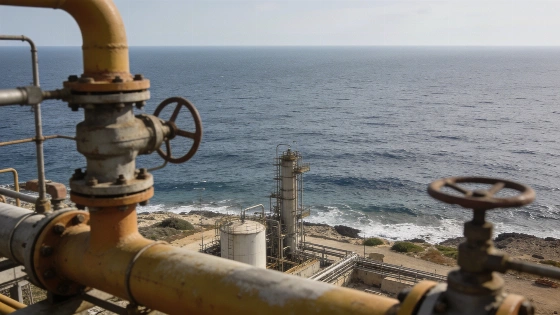
The seabed already carries economic infrastructure. The 516-kilometre GreenStream pipeline runs from Mellitah on Libya's coast to Gela in Sicily. It carries Libyan-produced gas to Italy. A company jointly owned in equal parts by Eni North Africa and Libya's National Oil Corporation operates the pipeline. Its route shows why maritime stability matters to energy producers, transit arrangements and consumers on both sides of the Mediterranean.
Submarine communications cables add another strategic concern. The European Commission estimates that around 99 per cent of intercontinental internet traffic passes through these cables. In 2026, Brussels introduced a Cable Security Toolbox and funded new tools to protect networks. Maritime boundaries can affect where states and companies seek to route pipelines and cables or install offshore infrastructure. The stakes reach the seabed.
Greece's dispute with Libya is tied to Turkey's role. Athens rejects the 2019 memorandum signed by Ankara and the Libyan government of the time. Greece argues that the memorandum disregards the maritime rights of Greek islands, including Crete. Turkey supports Libya's position. Athens sees that support as a challenge to Greek claims.
Energy exploration has sharpened the competing claims. Athens has continued exploration south and south-west of Crete. In February 2026, a consortium led by Chevron signed agreements to explore for natural gas in four deep-water areas off southern Greece, including areas near Crete and the Peloponnese. Some of those areas overlap with zones Libya claims under its maritime position and the memorandum with Turkey.
Italy's immediate task is narrower than a new regional alignment. Rome must defend its stated rights while maintaining relations with Libya, a country relevant to its energy needs. The filings do not settle boundaries or establish a three-country agreement. They put the legal disagreements on record. The next test is whether the states can negotiate delimitations without letting overlapping claims obstruct infrastructure and resource decisions tied to the seabed.