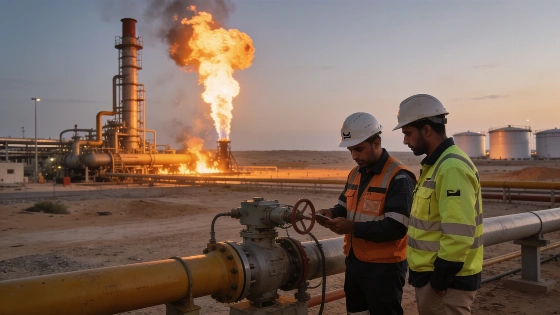
Libya's government has announced plans to raise daily gas production to 4 billion standard cubic feet within five years, signaling a major push to monetize discovered reserves and reposition the country in regional energy markets.
Libya is planning a sharp increase in natural gas production, with the Government of National Unity setting a target of 4 billion standard cubic feet per day within the next three to five years. If reached, this would be the country's largest production jump since 2011. Oil and Gas Minister Khalifa Rajab Abdusadek announced the goal at the Gastech 2026 forum in Bangkok, according to the event program and reports from the Algerian Press Service (APS).
The National Oil Corporation of Libya reported about 77 billion cubic feet of gas produced in August 2026. The new target would mean raising output by more than 55% over current levels. Minister Abdusadek said the plan relies on already discovered resources-both free gas and associated gas-rather than new exploration. This approach was also outlined in recent statements from the Libyan Ministry of Oil and Gas and reported by Tunis Afrique Presse (TAP).
Tripoli's new gas ambition
Gas has long taken a back seat to oil in Libya, but changing regional demand and the global energy transition are shifting priorities. If Libya meets its new target, state revenues could rise and the country could become a more reliable supplier to Mediterranean markets. Official figures show oil and gas sector revenues for January to August 2026 reached $15.2 billion, with about $900 million from sales of natural gas, condensates, and petroleum products, according to data released by the Libyan government and cited by the Maghreb Arab Press (MAP).
Libya is also using more of its gas at home. In September 2026, gas supply deals were signed for the first phase of a major industrial complex in eastern Libya. This reflects a broader effort to use energy resources for national development, similar to strategies in Algeria and Tunisia, where state-backed energy projects are central to economic diversification, as noted in recent United Nations Economic Commission for Africa (UNECA) reports.
Risks and regional context
Reaching 4 billion cubic feet per day will not be easy. Libya's energy sector still faces political divisions, security threats, and infrastructure challenges. As previously reported, ongoing instability has repeatedly disrupted oil and gas operations, making ambitious targets vulnerable to events on the ground. The African Union's Peace and Security Council and other regional observers have pointed out that stability in Libya's energy sector depends on broader diplomatic efforts and cooperation with Maghreb neighbors.
For European and regional buyers, Libya's promise of higher gas exports is appealing but comes with questions about reliability. The government's ability to deliver will depend on stabilizing the sector, attracting investment, and managing the country's complex institutions. Recent official ministry releases on energy talks with Tunisia and Algeria highlight the need for regional coordination to reach these goals.
What to watch next
Investors and analysts will be looking for specific project announcements, new joint ventures, and signs of infrastructure upgrades. The government's credibility now rests on turning this plan into real progress. For now, Tripoli's push for higher gas output is a high-stakes move that could reshape the country's economy-or reveal the limits of what is possible in a sector still affected by instability.