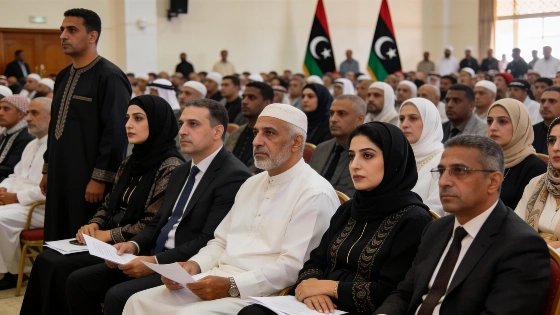
More than 500 delegates from Libya's monarchist movement met in Misrata, hoping to build a political base and revive the 1951 constitution as a way to reach national elections and stability.
Libya's politics have long been shaped by armed groups and competing governments. Now, a new monarchist movement in Misrata is trying to change that. Over 500 delegates came together in the city, not to support a militia or a foreign-backed authority, but to call for a constitutional monarchy as a national solution. Reports from EU Reporter and IBTimes UK confirm that hundreds of participants arrived from Libya's main cities. This kind of cross-regional turnout is rare in a country split by years of conflict.
The Misrata conference was different from the usual tribal or factional meetings. Ahmed Al Naas, who leads the Misrata branch of the Higher Coordination Council of the Royal Movement, called it a big step toward the national foundation Libyans have wanted for years. He said the 1951 Independence Constitution, which once gave Libya its sovereignty, could be updated to create a unifying head of state-one not tied to whichever armed group controls Tripoli. The movement's plan is based on Libya's original hereditary constitutional monarchy, which had a parliament and a federal system linking Cyrenaica, Tripolitania, and Fezzan. This is backed up by IBTimes UK and regional historical records.
Monarchists try to break the political deadlock
Libya has not held a national election since 2014. The last planned presidential vote, set for December 2021, was canceled at the last minute. Since then, politics have revolved around militias, rival governments, and a steady stream of UN envoys. The monarchy movement is taking a different route. It is building local chapters, picking delegates, and trying to form a political base that goes beyond regional and factional lines. Crown Prince Mohammed El Senussi, named by both EU Reporter and IBTimes UK as the movement's leader and heir to the Senussi throne, has spent two years talking with tribal sheikhs, politicians, and community leaders across Libya. His message is steady: the 1951 constitution once united the country, and a constitutional monarchy could give Libya a stable way to hold elections and govern.
In August 2026, 75 members of the High Council of State sent a letter to the UN Secretary-General backing this constitutional path. This fits with a wider push for international mediation based on a real constitutional framework. The movement's National Forum for Unity and Peace has also brought together political figures in Tripoli under the slogan "constitutional monarchy: the path to resolving the Libyan crisis." Regional agencies like Tunis Afrique Presse (TAP) and the Algerian Press Service (APS) have reported on the growing calls for a return to constitutional legitimacy as a way to break the deadlock.
Testing support and challenging old views
For years, critics wrote off the monarchy as an eastern, Cyrenaican idea with little support in Tripolitania. By holding its conference in Misrata-a city known for its powerful armed groups and as the home of Prime Minister Abdulhamid Dbeibah-the movement showed it wants to build support in western Libya. The symbolism runs deep. The flag raised by Misrata's revolutionaries in 2011 was the old kingdom's flag. The city's stand against Gaddafi's siege is still a source of pride. The conference came as the UN renewed efforts to unify Libya's executive and hold elections within two years. But as reported earlier, even technical steps toward a national framework have struggled. Institutions remain divided, and rival claims to legitimacy persist. The High Council of State refused to join the latest UN-brokered deal, and the House of Representatives faces dissent over its support for the agreement.
On 30 August 2026, the "4+4" committee, with UN backing, signed a deal in Tripoli to restructure the High National Elections Commission and settle disputes over election laws. But on 22 September, the High Council of State and several political parties publicly rejected the "4+4" outcomes. They insisted that any new arrangements must not override the Constitutional Declaration or the authority of legitimate institutions. They also called on the United Nations Support Mission in Libya (UNSMIL) to act only in a supporting role and to respect Libya's sovereignty, as reported by Xinhua and diplomatic notes from the African Union Peace and Security Council.
The monarchy movement responded carefully. It welcomed international efforts but said Libyans must take the lead. The movement rejected any deal that would keep the current chaos or block citizens from having a real say in their future. The group's lack of an armed wing is central to its identity. It presents itself as a civic alternative, not another faction fighting for territory, oil, or foreign backing. This stands out in a region where, according to Amnesty International, at least 30 executions were carried out by the Libyan National Army in the east after closed military trials since August 2026. The need for a legitimate, civilian-led political process is urgent.
Limits and prospects for a constitutional path
The monarchy movement faces big hurdles. The prince is still abroad. The movement has no brigades. There is no reliable polling to show how much support it has. Even a large conference does not mean a majority. The real test will be whether the movement can turn its talks and local chapters into a base strong enough to survive Libya's constant political pressure. Regional observers, including the Moroccan news agency MAP, have pointed out that similar civic movements in the Maghreb have struggled without strong institutional support or international guarantees.
Still, the Misrata meeting showed that an organised group inside Libya is ready to argue for a constitutional alternative-and to see if that idea can spread beyond the conference hall. In a country where most political moves depend on armed power or foreign mediation, the monarchists' effort to build a cross-regional, civilian-led platform is a clear break from the norm. Whether it works or not, the movement's push to challenge old narratives and organise openly in western Libya shows that the fight over Libya's future is not over. New political actors are determined to claim a place in whatever comes next. For ongoing updates on regional diplomatic developments, readers can check the official Tunisian Ministry of Foreign Affairs.