Morocco's authorities have escalated their response to the GenZ 212 movement with over 6,000 detentions and harsh sentences, marking the most severe judicial crackdown of King Mohammed VI's reign and exposing the regime's evolving tactics to suppress opposition.
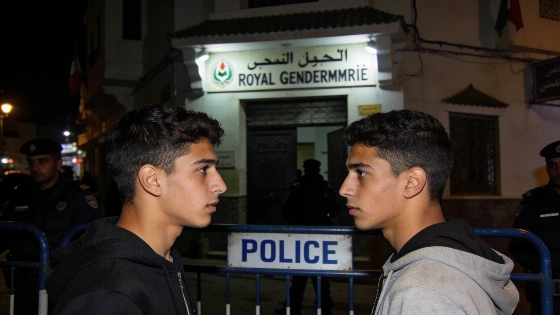
Three young protesters were killed outside a Royal Gendarmerie barracks near Agadir, shot by uniformed officers who later claimed they were defending their families. The protesters had only their voices and their presence. Within hours, authorities searched nearby homes, trying to erase video evidence of the shootings. They did not succeed. Footage spread quickly on social media, breaking through the regime's official narrative and revealing the violence at the center of its response to the GenZ 212 movement.
This was not a one-off. The state's response to GenZ 212 has been broad and unyielding. According to EFE and the Moroccan news agency MAP, at least 6,000 people were detained during the crackdown. As of September 2026, official figures show 662 people still held in 52 prisons. Of these, 108 are continuing their education or vocational training, according to the General Delegation for Prison Administration and Reintegration (DGAPR) in July 2026. Charges have included armed rebellion, incitement, and violence against law enforcement-broad categories that allow the courts to target almost anyone who protests. Sentences have been harsh and fast, with hundreds of years of prison time handed down and, in a disturbing turn, convictions of children under twelve (Infobae/EFE).
From military violence to judicial machinery
Morocco's methods of repression have changed since the violent decades under King Hassan II. The Casablanca uprising in 1965 and the bread riots of the 1980s were met with open military force, leaving thousands dead. Under King Mohammed VI, the army stays in its barracks. Instead, the political police and the courts have become the main tools of control, a shift noted by regional observers and confirmed in recent statements from the Ministry of Interior.
Surveillance technology-much of it provided and taught by Israeli partners-now allows the state to monitor, harass, and blackmail dissidents with new precision. The creation of a special tribunal in Salé, justified as a defense against "Islamist terrorism," has given the regime a legal system ready to prosecute anyone who crosses certain lines: criticism of the monarchy, the Western Sahara conflict, or Islam. The Moroccan Press Agency (MAP) has reported on the expansion of these judicial powers as part of national security reforms.
Major protest waves-Sidi Ifni in 2008, Safi in 2011, the February 20th Movement, the Hirak of the Rif, and now GenZ 212-have all faced a mix of co-optation and coercion. The state offers rewards to movement leaders willing to cooperate; those who refuse face surveillance, fabricated charges, and public trials meant to send a message to others.
The GenZ 212 crackdown and the mechanics of repression
The GenZ 212 movement began in September 2025 after eight pregnant women died at Hassan II Hospital in Agadir. This event sparked mass protests demanding better healthcare, education, and social services. The episode, documented by ARTE and confirmed by EFE, marked the start of the harshest judicial crackdown of Mohammed VI's reign. State data shows thousands detained, mass trials, and sentences that far outweigh the alleged offenses. In one case reported by journalist and former prisoner of conscience Omar Radi, twenty-four young people-including six minors-were arrested in Casablanca after a peaceful half-hour road blockade. Their "confessions" to the police were nearly identical and filled with political language unlikely to come from teenagers. Many later recanted before the judge, citing alibis and saying they were pressured to sign statements they had not read. The judge ignored defense witnesses and refused to review phone location data that could have cleared the accused. The only evidence was a short surveillance video in which most defendants could not be identified.
These are not isolated cases. The pattern is familiar: forced confessions, ignored evidence, and a judiciary that sides with the prosecution. A brief protest can mean years in prison for minors, and the threat of punishment hangs over anyone who speaks out. According to RFI, more than 600 people remain in detention as of September 2026, and supporters of the movement continue to focus on legal aid and advocacy for those still imprisoned.
King Mohammed VI has remained silent in public. When he addressed Parliament on October 10, 2025, he did not mention the unrest or the deaths. Two weeks later, the government announced more spending on health, education, and youth election funds-an attempt to calm the situation without addressing the main grievances or releasing detainees. The message is clear: the regime will alternate between budget promises and judicial threats, but the machinery of intimidation stays in place. The Ministry of Economy and Finance has published updates on these budget allocations, though civil society groups say implementation is still unclear.
Strategic consequences and the regional context
The shift from military to judicial repression is not just a domestic matter. It is a calculated response to an era of global media and digital activism. The regime has learned that military violence draws international outrage, while courtrooms and legal language offer a cover of legitimacy. But the goal remains the same: to silence dissent, not to negotiate with it.
This approach has effects beyond Morocco. The use of surveillance technology and foreign training-especially from Israel-shows a willingness to import methods from other authoritarian states. The judiciary's role as an arm of executive power undermines any claim to independent rule of law, raising concerns for international partners and investors who must consider the risks of working in a system where legal outcomes are politically decided. Regional news agencies such as Algeria's APS and Tunisia's TAP have reported on how Morocco's internal security policies affect Maghreb cooperation and cross-border civil society networks.
At the same time, the regime's refusal to engage with protest movements risks widening the gap between Morocco's rulers and its young population. As the 2026 parliamentary elections approach, the government's preference for repression over reform stands in contrast to the ambitious social spending plans recently reported earlier by opposition groups. The struggle between official co-optation and grassroots mobilization is ongoing.
Morocco's rulers have replaced military force with judicial control, but the result is the same: dissent is criminalized, and promises of a "new era" remain unfulfilled. The regime's reliance on the courts may bring short-term calm, but it comes at the cost of legitimacy and trust. As long as the machinery of intimidation remains, Morocco's political future will be shaped by control, not by dialogue or reform.