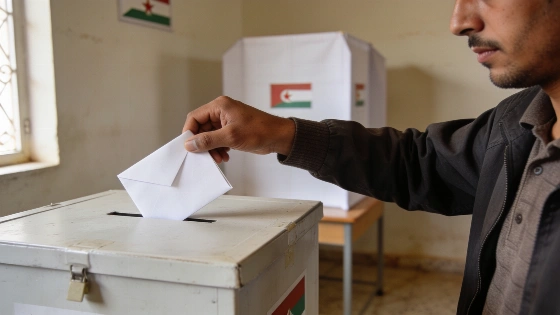
On September 23, 28 parties and 7,288 candidates contested Morocco's parliamentary election. Turnout was 38.08%, and the author argues that the ballot cannot change who holds decisive power or answer young people's demands for public services and accountability.
On September 23, 2026, voters faced a ballot with 28 parties, 1,850 lists and 7,288 candidates. The author argues that a crowded ballot cannot bring political change when decisive centres of power sit outside electoral competition. On October 1, the Ministry of the Interior said the final results matched the preliminary figures. Its final-results announcement confirmed the match.
The turnout figures offer another measure of the election's limits. The Party of Authenticity and Modernity (PAM) won 97 seats in the preliminary tally, according to a Ministry of the Interior announcement published on October 2. Minister of the Interior Abdelouafi Laftit reported turnout of 38.08%, down from 50.86% in 2021 and 42.27% in 2016. The figures do not explain why people abstained. They do show how hard it is to turn formal competition into broad public engagement. The numbers are stark.
The vote came after a year of youth protests and a fall in voter registration among younger Moroccans. More names on the ballot have not, in the author's view, produced meaningful pluralism. An International Republican Institute technical assessment said the 2026 campaign took place under an updated legal framework. The rules included measures intended to widen opportunities for smaller parties, encourage youth participation, strengthen campaign-finance accountability and regulate digital campaigning. Those measures change the rules of competition. They do not answer the author's central question: where does decisive political authority lie?
The Ministry of the Interior said it sent a central inspection team to investigate alleged irregularities at two polling stations in the Tangier-Assilah constituency after reports of problems on election day. An investigation does not prove misconduct. Public confidence depends on complaints being examined transparently and the findings being made clear.
Maghreb Insider's public-trust analysis raises a related question: can political promises deliver better services and jobs?
The Ministry of the Interior oversees the electoral process, including constituency boundaries and voting. But the article argues that Morocco is not simply an imperfect democracy waiting for incremental reform. It describes a system where the king and his advisers hold decisive authority. Parliament and government operate within limits set elsewhere. Successive heads of government, the author says, have described their mission as carrying out the royal agenda.
In this account, parties compete less over who sets national policy than over who can put it into practice and manage public anger. The author levels the same criticism at the opposition. Parties promise jobs, dignity and a social state, but avoid specific answers on taxation, debt, regional inequality, food and water security, and the cost of major projects. These questions matter across North Africa. The election figures here, though, apply to Morocco alone. They are not evidence of political participation in Algeria, Tunisia, Libya or Mauritania. The distinction matters.
The GenZ212 movement began on September 27, 2025, and gave that discontent a public face. Organised through Discord, it reportedly grew to more than 220,000 members within days. Its demands centred on healthcare, education, jobs and fighting corruption. Thousands demonstrated in Rabat, Casablanca, Agadir, Marrakech, Fez and smaller towns. They called for better public services and the government's resignation.
Arrests and prosecutions followed the protests. The article reports that three people died in Laqliaa near Agadir during the demonstrations. Later reporting said hundreds of young people were still detained or imprisoned a year after the uprising, with lengthy sentences in some cases. These accounts describe an ongoing confrontation between youth protest and the political system. They are separate from the allegations of polling-station irregularities under investigation in Tangier. Protesters addressed the king directly, rather than the government. The author reads that choice as a sign that many young people had lost faith in parties and ministers.
By the 2026 election, the share of registered voters aged 18-24 had fallen from 8% to 4%. For those aged 25-44, it dropped from 19% to 15%, according to figures cited in the article. The author calls the decline a silent referendum on the party system. The International Republican Institute's assessment offers a counterpoint. Updated electoral rules may widen participation and improve campaign oversight. Their effect will depend on whether voters see meaningful choices and accountable institutions. Rules alone are not enough.
The article also ties political limits to economic choices. The government promised one million jobs in 2021, but youth unemployment remained among the region's highest, it says. The author also argues that the pledge to build a social state sits uneasily with deteriorating public services and a governing structure that serves a narrow economic elite. The article gives no comparable regional employment or budget data. These claims should therefore be read as its assessment of Morocco, not as a ranking of Maghreb economies.
Billions are being spent on stadiums and other preparations for the 2030 World Cup, while the article describes shortages in hospitals and schools. It calls on parties to offer credible alternatives on redistribution, tax policy, public debt, healthcare and education. Broad campaign slogans are not enough.
The author proposes collective political change rooted in local control of land, water, energy and minerals, along with food, financial and cultural sovereignty. These are arguments for a different model. They are not policies adopted by the election.
In the author's reading, the election matters less for the number of lists than for the gap between electoral competition and the authority voters can change. Parties that cannot offer specific choices on public services, jobs and economic power risk renewing the same system at the next vote. The demands that brought young people into the streets would remain unanswered. The author's verdict is clear: ballots alone cannot bring liberation when the structure of power remains beyond the ballot box.