
Signed in Rabat, the Morocco-Mauritania framework covers work on about 480 kilometres of road between Nouakchott and Nouadhibou, linking Mauritania with the El Guerguerat crossing. It sets out preparatory steps, not a confirmed start to construction.
Morocco and Mauritania signed the framework in Rabat on September 21, 2026. It covers the rehabilitation, widening and modernization of about 480 kilometres of road between Nouakchott and Nouadhibou, with a connection to Morocco's road network at PK55/El Guerguerat.
The agreement sets out engineering support, expertise from both countries, and ways to monitor and supervise the work. Reports also refer to a joint studies bureau in Mauritania. These are preparatory steps. No start is confirmed.
The route's role in trade
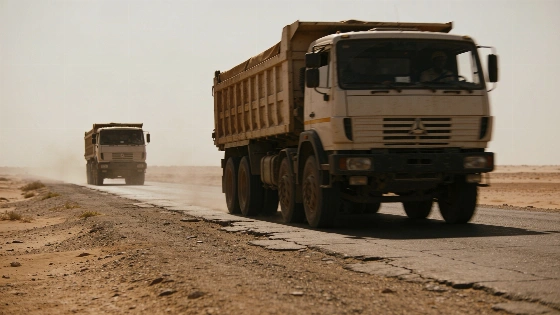
Mauritania's RN4 links the political capital, Nouakchott, with Nouadhibou, the country's port and economic centre. From there, the road continues toward the crossing opposite El Guerguerat. Heavy freight and passenger traffic use the route between Mauritania and Morocco, so its condition affects trade between the two countries.
The crossing reopened in November 2020 after a period of disruption. That restored cross-border movement and reinforced the route's role in regional commerce.
Morocco's Minister of Equipment and Water, Nizar Baraka, signed the agreement with Mauritania's Ely Ould El Veirik, according to reports on the signing. The deal is bilateral, but the road links Nouakchott and Nouadhibou with Morocco's road network and the border crossing. Trade can move in both directions.
A wider regional connection
A broader corridor plan runs from Tangier through southern Morocco, Nouadhibou and Nouakchott, then toward Rosso, Saint-Louis and Dakar. This is a regional connectivity concept, not a single completed route. Its usefulness will depend on the condition and capacity of separate roads, as well as coordination at border infrastructure across several countries.
Other projects could add to that network. They include Morocco's Tiznit-Dakhla expressway and motorway, along with bridge and road projects in Senegal, including works linked to the Dakar-Saint-Louis axis and the Senegal River crossing. Their schedules and delivery are separate from the Morocco-Mauritania framework.
These links are sometimes discussed as part of the wider Tangier-Lagos trans-African highway. The new agreement covers only the Mauritanian road section. It does not commit the signatories to construction across the full regional corridor.
For updates on implementation, the official Moroccan news agency MAP and Mauritania's state news agency AMI are relevant channels. Any later announcement on financing, procurement or a construction start would be separate from the framework agreement reported so far. No investment volume is specified in the available coverage.
Morocco's economic outlook also features in a separate argan oil forecast. That projection concerns a market, not cross-border transport infrastructure.
The next question is whether the framework leads to the planned road work. More capacity could support freight and passenger traffic between Nouakchott, Nouadhibou and the El Guerguerat crossing. Any economic gains will depend on implementation and on connected infrastructure beyond the project's stated scope. The wider regional plan depends on delivery.