
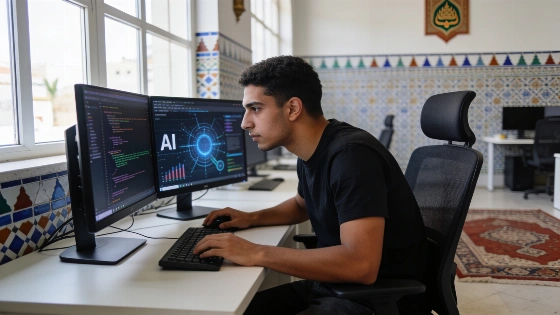
The World Bank's 2026 report singles out Morocco as both a model and a warning for AI in developing economies, highlighting the stakes for jobs, productivity and national strategy as global tech giants outspend entire countries.
Morocco is at a crossroads in the global push to use artificial intelligence. The World Bank's 2026 World Development Report points to Morocco as both a regional leader and a country that could fall behind. The stakes are clear: AI could help Morocco reach its economic goals, or it could make existing problems-like high youth unemployment and fragile service exports-even worse. The Moroccan Press Agency (MAP) has reported that the government sees digital transformation as key to staying competitive, echoing the World Bank's sense of urgency.
By 2026, the world's biggest tech companies are spending more on AI infrastructure than the entire economies of many developing countries. For Morocco, this means there is little time left to shape its own path. The World Bank's report, "The Promise of Artificial Intelligence," warns that the next wave of economic change will not wait for those who move slowly. In September 2026, Morocco's Ministry of Digital Transition began putting the "Maroc IA 2030" roadmap into action, aiming for 100 billion dirhams in added GDP, 50,000 new jobs, and 200,000 certified AI specialists by 2030, according to an official government release.
AI brings both promise and risk
The World Bank's warning is direct: AI could help solve long-standing development problems, but it could also concentrate power and increase dependency. Morocco is highlighted for its AI Xcelerate Morocco training program and the "Morocco AI 2030" strategy, but also flagged for its vulnerability to job losses in service exports-a sector already under pressure from automation and global competition. The government's strategy focuses on three areas: sovereignty and trust, innovation and competitiveness, and international influence, supported by ten structural programs, according to the Ministry of Digital Transition and Digitalization.
Other countries' experiences show what's at stake. In Nigeria, a medical AI tool trained on foreign data failed to work well locally. In India and Kenya, AI systems tailored to local needs have helped farmers and courts. Morocco faces a similar challenge: avoid importing solutions that don't fit, and instead adapt AI to local languages and realities. This is reflected in its partnership with Mistral AI to develop models for Darija and Amazigh. The Tunis Afrique Presse (TAP) agency has reported on similar efforts across North Africa, showing how important local context is for AI projects.
Adopt, adapt, advance-or risk falling behind
The World Bank recommends a three-step approach: adopt proven AI tools, adapt them to local needs, and only then try to build homegrown models. For most developing countries, including Morocco, the cost of top-tier AI infrastructure is out of reach. The report notes that by mid-2026, more than 80 countries had published national AI strategies, but among low-income countries, only Rwanda had done so-highlighting the gap between plans and action. Morocco's efforts to train talent and localize AI are timely: as of September 2026, 47,153 AI specialists had been identified and certified, nearly 48% of the 2030 target, according to Maroc.ma and H24info.
Morocco's young workforce could see productivity gains if AI is used wisely, but the same technology could speed up job losses if adaptation falls short. The region's high unemployment and economic fragility make the stakes even higher. The AI Xcelerate Morocco program, launched in December 2025 with support from the General Confederation of Moroccan Enterprises (CGEM), is cited by MAP as a model for sector-specific AI training in agriculture and industry.
Decisions ahead will shape Morocco's future
The World Bank's message is clear: countries that do not build reliable infrastructure, invest in education, and strengthen institutions will be left out of the AI era. For Morocco, the next steps will decide whether it becomes a regional AI hub or an example of missed opportunity. The "adopt, adapt, advance" approach is not just a slogan-it's a survival strategy in a world where technological power is concentrated in a few countries and companies. The Ministry of Digital Transition has already started projects like the first Jazari institutes, a national Data Factory, and a software forge, and is drafting the "Digital X.0" law, now under government review, as reported by TechReviewAfrica.
Morocco's focus on AI training and language-specific models shows it understands what's at stake. But there is still a gap between policy and real-world results, and the cost of failure is rising. If Morocco can turn its strategies into actual gains-higher productivity, better public services, and new economic opportunities-it could become a model for the region. If not, it risks missing out on the next wave of technological change, with real consequences for jobs, competitiveness, and dependence on foreign platforms. The window for gradual steps has closed. Morocco's AI moment is here, and the outcome will depend on what happens next.