

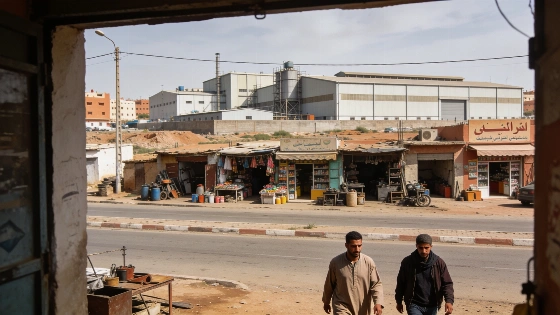
A study estimates a strong link between unemployment in Moroccan municipalities and rates in nearby areas. Its five-part map of local economies, set against high national unemployment and uneven job creation, points to employment policies that cross administrative boundaries.
The study puts the spatial effect at 0.548. A one-percentage-point rise in average unemployment in surrounding municipalities is associated with a local increase of about 0.55 points, after other factors in the model are taken into account.
That finding challenges the idea that employment can be understood or addressed municipality by municipality. Morocco's local labor markets are connected, though the study could not track workers' daily movements. The national figures are stark: the High Commission for Planning (HCP) reported that unemployment reached 13% in 2025, affecting 1.621 million people. The rate was 37.2% among people aged 15-24 and 20.5% among women.
The HCP's 2025 figures also show why local economic profiles matter. Morocco recorded a net gain of about 193,000 jobs. Services, construction and industry gained jobs, while agriculture, forestry and fishing lost 41,000. The gains were uneven. Exposure to different industries can shape job prospects from one area to another.
Women's access to work remains a national constraint alongside these geographic differences. In 2025, women's labor-force participation was 19%, compared with 68.5% for men. The employment rate among women of working age was 15.1%, according to HCP. These national measures do not show conditions in each municipality. They do show why local job planning must account for barriers to participation as well as unemployment.
Researchers grouped municipalities using business density, the mix of industrial and service activity, stable employment, capacity to absorb workers, basic education and the presence of public institutions. The analysis used High Commission for Planning data from the 2024 population and housing census and the 2023-2024 national economic establishments map. Published in Networks and Spatial Economics, it identified five broad profiles. Five profiles emerged.
The two largest groups were 586 municipalities with relatively strong service activity and 580 economically vulnerable municipalities. In the latter group, business density and capacity to absorb workers were low. Basic education indicators were also weaker.
Another 252 municipalities had relatively higher education levels but only moderate economic activity. At the other end of the employment profile, 82 municipalities qualified as "integrated economic hubs." They had the highest levels of business density, stable jobs, labor absorption and education.
Public institutions set 23 municipalities apart. The indicator for their presence was nearly six times the national average, while private-sector activity was comparatively weaker. Seventeen municipalities were excluded because they were isolated within the study's network of neighboring areas.
The differences also show up between larger regions. HCP reported a 9.4% unemployment rate in the Tangier-Tetouan-Al Hoceima region in 2025, below the national rate of 13%. The region had 4,030,222 residents in the 2024 census. These regional figures are not directly comparable with the study's municipal classifications. They still show how much employment conditions vary across Morocco.
High-unemployment municipalities tend to be surrounded by other areas with high unemployment. Low rates also cluster geographically. Researchers found links between neighboring municipalities in education, industrial activity and public-sector presence. These statistical relationships do not prove that conditions in one place directly cause outcomes in another.
The analysis maps similarities and geographic relationships, not commuting routes. It has no direct information on daily travel to work, so it cannot show how many people cross municipal boundaries for jobs or where they go. The World Bank's labor analysis also identifies weak private-sector job creation, high youth unemployment, low female participation, territorial disparities, human-capital gaps and recurring drought as key constraints in Morocco.
The findings add a geographic dimension to the jobs-and-services challenge discussed in an earlier analysis. The practical problem is clear: a municipality's employment prospects may depend on its wider local network, not just its own business base.
Regional data can sharpen the picture, but they cannot settle the question of cause. HCP's municipal and regional statistics let researchers compare labor-market conditions. The study's spatial estimate suggests that employment planning should also consider how neighboring areas relate to one another.
The study proposes better infrastructure and training in vulnerable areas. It also calls for transport, housing and job opportunities suited to local skills around major economic hubs. The data do not establish which intervention would work best. Nor do they show how workers currently move between municipalities.
Morocco's employment planning should account for connected municipalities rather than treat administrative boundaries as economic walls. The study does not prove that neighboring conditions cause unemployment. But its measured spillover is substantial enough to show why planning one municipality at a time may not fit the labor-market map it describes.