
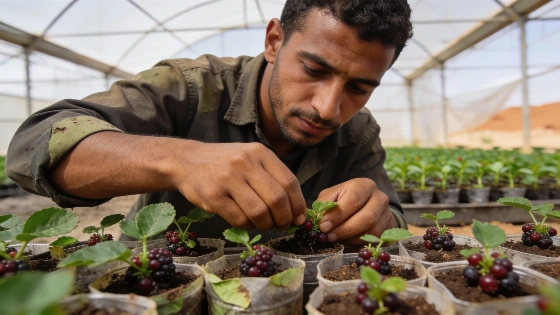
Frutivar says its first berry plants combine Chilean propagation expertise with Les Domaines Agricoles' laboratory capabilities. Available results do not independently confirm the project's scale, supply volumes or the number of growers involved.
Initial plant material was reportedly shipped from Chile and rooted at Frutivar before delivery to growers in Morocco. Frutivar says the project includes partnerships with MBO, OZblu and Hortifrut, giving Moroccan producers access to their variety programmes. Available research has not independently confirmed these details.
The next test is whether the first reported plantings can support a reliable local production model. Frutivar is described as building infrastructure and production capacity. But verified figures for investment, nursery capacity, plant output, planted area, supply volumes and participating farms are not available. The numbers are missing.
The arrangement brings together Grupo Hijuelas' nursery, genetics and propagation expertise with Les Domaines Agricoles' laboratory, agricultural and commercial capabilities. These operational details come from the project account. Independent public documentation has not confirmed them.
Grupo Hijuelas has experience in plant propagation and genetics, with operations described in Chile, Peru, Mexico, Brazil, the United States and France. A report dated 1 October 2026 says the company continues research and plant propagation in Osorno, Chile, where it has worked for about a decade. That activity offers context for its propagation experience, but it does not verify Frutivar's Moroccan production plans.
El Bassatine began operating in 1984 to help restore Moroccan palm groves affected by Bayoud disease. The project account says its in-vitro work now covers date palm, banana, rosaceae and cactus, and that Frutivar is extending this capability to berries. FreshPlaza's SIAM 2024 photo coverage also documents Les Domaines Agricoles' participation in an agriculture-focused event. It shows the group's wider role in fruit and vegetable production for domestic and export markets. Context, not proof.
Grupo Hijuelas' EMEA head, Remo Nasi, described the partnership as a way to draw on the company's development experience and established results. Les Domaines Agricoles Deputy CEO Badr Bennis said Frutivar extends the company's in-vitro work to new species and gives it access to international genetic programmes. Those statements explain the companies' rationale. Verified production and investment figures remain unavailable.
Frutivar is also presented as a way to add new genetics to the group's portfolio and support technical exchange and training between the companies. The investment case fits wider attention to Morocco's business environment and trade access, discussed in a U.S. investment-climate report.
The project announcement said representatives planned to present Frutivar to growers, exporters and other industry participants at Fruit Attraction in Madrid from 6 to 8 October. Available results do not confirm whether those meetings took place or led to new agreements. No independent communiqué from Morocco's Ministry of Agriculture or report by state news agency MAP was found to verify the project's parameters. MAP's general news coverage does not, by itself, confirm the venture.
For now, Frutivar is a company-reported effort to pair local laboratory capacity with international berry genetics, not a publicly documented national production programme. Its significance will depend on what Moroccan growers can access and establish beyond the first reported deliveries. Future verifiable information will need to clarify output, investment and participation.