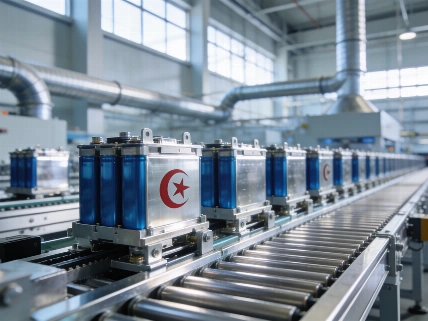
Chinese firms are expanding Morocco's battery-cell and cathode capacity, but undisclosed lithium sourcing leaves the scale of any new demand uncertain as prices and mine-supply expectations shift.
China produced more than 12 million electric vehicles in 2024 and exported 1.25 million, predominantly to Europe. New EU duties are prompting manufacturers to reconsider where they make vehicles and components.
Shanghai Metals Market (SMM) puts Chinese companies' announced investment in Morocco's battery and EV-component sector at about US$6 billion. The projects are at different stages of development. SMM says the plants would consume lithium chemicals once operating, but the companies have not disclosed where they will source lithium, how much capacity they plan or when production will start. The scale of additional demand remains unclear.
Trade policy meets Morocco's manufacturing base
In October 2024, the EU introduced additional countervailing duties on Chinese-made battery electric vehicles following an anti-subsidy investigation. The rates vary by manufacturer and are added to the bloc's standard vehicle import tariff. The measures apply to vehicles made in China. Production in Morocco does not automatically establish preferential origin under EU customs rules.
Morocco already has a substantial automotive industry, with Renault and Stellantis operating in the country. The sector exported US$17 billion worth of vehicles and parts in 2024, making Morocco one of the EU's largest automotive trading partners, ahead of China.
The country produced 560,000 vehicles in 2024, of which around 50,000, or 9%, were electric. EV and battery production still has room to grow from a relatively small base. Morocco's broader economic goals also feature in a growth programme that includes a major investment push.
SMM reports that Morocco has spent two decades developing industrial zones and export infrastructure. Tanger Med and trade links with Europe support its role as a manufacturing and logistics hub. The country also holds approximately 68% of the world's phosphate rock reserves and produces cobalt, both used in battery supply chains.
Several projects are adding manufacturing capacity. In March 2024, China's BTR New Material Group signed an agreement to invest more than 3 billion dirhams in a Moroccan lithium-ion cathode-materials plant. Figures attributed to Morocco's Ministry of Economy and Finance put its planned capacity at 50,000 tonnes a year and project 2,448 jobs, including 504 direct positions by 2027. The project is geared towards European exports, according to Industrie Du Maroc.
At Jorf Lasfar, COBCO, a joint venture between Morocco's Al Mada and China's CNGR, opened its industrial site on 25 June 2025. The project involves a reported investment of 20 billion dirhams across more than 200 hectares. Its planned output includes NMC battery precursors and LFP cathodes. The project also plans black-mass recycling, with eventual materials capacity of up to 70 GWh a year. It is designed to supply components for about one million electric vehicles annually and create more than 3,600 direct and indirect jobs. In June 2025, COBCO introduced its first NMC precursor production line. The full project's stated capacity is a longer-term target, as detailed by LesMRE.
Gotion High-Tech is developing an LFP battery project in the Rabat-Salé-Kénitra region. Project descriptions have put the first phase at either 10 or 20 GWh annually. An earlier project account described a 20 GWh phase costing about $1.3 billion, while another report cited 10 GWh. In October 2025, an investment estimate exceeded 12 billion dirhams, with operations then expected to begin in 2026. Long-term expansion of up to 100 GWh was also discussed. These are planned battery capacities, not measures of lithium purchases.
Morocco's battery ambitions build on domestic phosphate and cobalt processing, as well as manganese processing. They also draw on the country's established automotive and export infrastructure. LFP and NMC production uses lithium compounds, but announced investment totals and battery capacities do not by themselves quantify actual lithium consumption.
Lithium prices and mine supply remain uncertain
On 12 October, the most active lithium carbonate contract on the Guangzhou Futures Exchange touched ¥104,680 ($22,355) per tonne, its lowest level since 17 December 2025. It later closed daytime trading at ¥104,740 per tonne, down 11.8%. That was its steepest daily fall since March.
According to SMM, the decline followed a China-EU agreement on hybrid vehicle exports and concerns about Chinese automotive exports and future lithium demand. The contract had also fallen from its May peak of ¥209,980 per tonne. Uncertainty about demand in 2027 weighed on sentiment.
The anticipated restart of Contemporary Amperex Technology's (HKG:3750) Jianxiawo mine remains a focus for market participants. SMM says speculation about the mine's operating status is influencing market sentiment.