

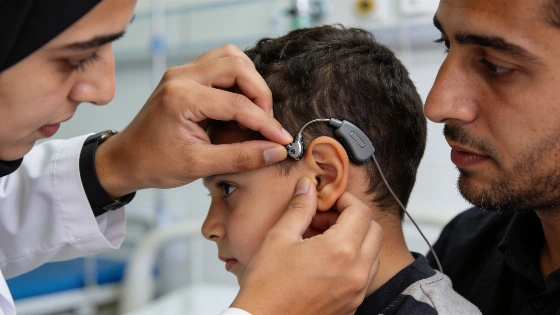
WHO projects disabling hearing loss will affect more than 700 million people by 2050. Morocco's continuous free pathway from neonatal screening to cochlear implantation is also being shared with Rwanda.
At Mohammed V Military Teaching Hospital in Rabat, teams performed Africa's first robot-assisted cochlear implantation on October 31, 2025. The procedure is part of a wider Moroccan model linking hearing care from early screening through rehabilitation and schooling, with educational support.
The Lalla Asmaa Foundation leads the pathway at the initiative of His Majesty King Mohammed VI, May God Assist Him, with the continued commitment of Her Royal Highness Princess Lalla Asmaa. It brings these services together under one institutional structure. The Foundation describes care from screening through cochlear implantation as free of charge. Its neonatal hearing-screening program began in 2023, linking early detection with diagnosis, implantation and ongoing support.
A connected care pathway
The World Health Organization (WHO) estimates that more than 700 million people could require hearing-related care for disabling hearing loss by 2050, while approximately 2.5 billion people could experience some degree of hearing loss. The WHO's World Report on Hearing estimates that about 430 million people currently need hearing rehabilitation, including roughly 34 million children.. Demographic ageing and exposure to excessive noise contribute to the global burden, as do medical and genetic causes.
In Africa, only one in ten people affected has access to assistance. Morocco launched its neonatal hearing-screening program in 2023. Moroccan institutional reporting says that more than 1,200 people have since received free cochlear implants, with procedures carried out by teams based in five cities across the Kingdom.
A reported study of 88 children who received cochlear implants in Morocco identified a genetic factor in 65.9% of cases, involving 28 genes. The findings relate to that study cohort and were reported as potentially supporting earlier screening and future therapies. The model also extends into education: the Foundation reports that 13 young people supported since childhood have graduated, including two doctorate holders. Support through education and toward employment sits alongside Morocco's planned youth training and first-work opportunities covered in earlier reporting.
Sharing expertise with Rwanda
Rabat hosted the first African Congress on Pediatric Cochlear Implantation in December 2025, bringing Morocco's pediatric cochlear-implantation experience to a regional forum. On October 15, 2026, Lalla Asmaa University opened in Rabat; the source describes it as the world's first inclusive university.
The Foundation's "United, We Hear Better" program brings together 23 countries across Africa, the MENA region and Latin America. Nearly 500 patients have benefited from the initiative. Rwanda became its 23rd country, and the partnership has entered a fifth phase. In Kigali, a joint mission by Moroccan and Rwandan teams enabled 50 cochlear-implant procedures and provided hearing aids to 56 children. The phase also included the inauguration of Rwanda's first hearing-diagnosis and rehabilitation center.
Morocco contributes specialist teams and a method established nationwide. The partnership is designed for local ownership, with partners taking up shared skills and applying them according to their own choices. Moroccan teams from major hospitals are working alongside their Rwandan counterparts. Lalla Asmaa Foundation president-delegate Karim Essakalli has presented the Moroccan pathway as extending from newborn screening through rehabilitation and schooling, with support toward employment.







