

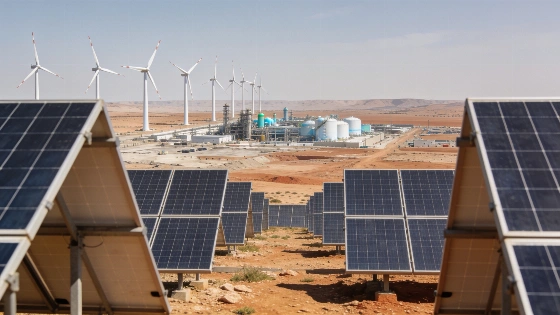
European industrial giants are committing billions to future low-carbon fuel supplies for the EU. But projects are lagging as costs rise, with buyers still scarce as Morocco emerges as the Maghreb's frontrunner.
Morocco aims to become a major green hydrogen producer and exporter. Algeria and Tunisia have set similar goals.
European industrial giants are seeking stakes in a future supply of low-carbon fuel for the EU. But commercial reality is lagging behind the ambition: across the region, plans remain tied up in development, feasibility studies and land procedures, with export volumes yet to materialize.
Projects face a widening market gap
Some projects have stalled as costs soar, while buyers remain hard to find. The proposed export model also depends on large renewable power, water, transport infrastructure, financing and European offtake agreements.
In Tunisia, TE H2 and VERBUND signed a memorandum of understanding with the government in May 2024 to study H2 Notos. Its initial phase is designed to produce 200,000 tonnes of hydrogen annually in the south, with a longer-term possibility of reaching 1 million tonnes. The proposed output would travel to Europe by pipeline. The memorandum launched study and development work. As commentator Imed Derouiche put it, "An announcement is not an investment decision."
African Manager reported estimates that show the scale of Tunisia's wider ambitions: by 2050, prospective projects could require around 100 gigawatts of renewable energy and water equivalent to one-quarter of the country's drinking-water needs. Infrastructure investment is estimated at about €117 billion. The hydrogen is intended for export to Germany and northern European markets, not for domestic consumption.
Algeria and Tunisia are also part of the proposed SoutH2 Corridor, a 3,300-kilometre pipeline route linking North Africa with Italy, Austria and Germany. Designed to transport more than 4 million tonnes of renewable hydrogen annually, it is intended to begin operating in the early 2030s. Algeria, Tunisia, Italy, Austria and Germany have backed development through a political declaration. Meanwhile, the Algeria-to-Europe Hydrogen Alliance is conducting preliminary feasibility studies on production, transport infrastructure and potential European buyers. Information from the corridor's reported design figures, its stated capacity could cover more than 40% of the EU's 2030 hydrogen-import target.
At a ministerial meeting on the Southern Hydrogen Corridor, EU Ambassador to Algeria Diego Melado described Algeria as a reliable gas partner and pointed to its potential in renewable energy and hydrogen. The corridor remains under development, with political cooperation and feasibility work underway.
Morocco takes the regional lead
All three countries have announced ambitions to become major producers and exporters. Morocco's pipeline includes eight major programs identified in an inventory by the German Institute of Development and Sustainability. They include MELHY, White Dunes, Chbika 1, Ornx, Taqa-Cepsa, Nareva and ACWA Power-linked developments. The plans cover hydrogen and green-ammonia production, as well as storage infrastructure. Investors named in the inventory include TotalEnergies, Taqa, Cepsa, Nareva, ACWA Power, China Three Gorges and UEG-linked partners.
After Morocco selected projects in March 2025, the next steps included land procedures and feasibility studies. A 2026 report by Bladi.net, citing the institute's inventory, said none of the eight programs had reached implementation. The next milestones are securing investment, obtaining permits and starting construction. Morocco is emerging as the region's frontrunner in announced projects, while Algeria and Tunisia advance their own production and transport plans.
Regional energy cooperation also extends beyond hydrogen, as covered in an earlier report on Algeria-Bangladesh ties. For the hydrogen race, projects remain stalled and buyers scarce.







