An October 2026 industry report counts 244 launched aquaculture projects with declared capacity of about 90,000 tonnes a year. That is a capacity figure, not proof of production; imported inputs and financing remain major tests.
A farm cannot turn its design capacity into saleable fish without reliable hatchery supply and feed. An industry report published on 5 October 2026 said Morocco had launched 244 aquaculture projects with combined declared capacity of about 90,000 tonnes a year. The reported industry figures do not show that farms are producing at that level. The National Agency for the Development of Aquaculture, ANDA, has a central role in developing the sector. Reaching the projected capacity will also depend on technology and financing.
Capacity is not output.
Morocco's broader marine economy gives the ambition some context. In 2025, marine fisheries and aquaculture together produced about 1.31 million tonnes. Production was valued at 15.5 billion dirhams, while reported sector value added reached 16.2 billion dirhams. Marine-sector export revenue came to 26.6 billion dirhams. That higher figure reflects processed products, not primary production alone, and none of these sector-wide totals should be mistaken for aquaculture output.
The same report counted 553 marine-industry establishments, including 165 new facilities during the government period it covered. Direct employment across the marine sector stood at 271,000 people in 2025. Fish processing accounted for 135,000 of those jobs. The existing industrial base could supply aquaculture, but project capacity alone says nothing about new jobs or the sector's economic contribution.
Most specialized aquaculture feed is still imported. Producers also rely on imported juveniles. Spat and post-larvae are imported too, exposing farms to added costs and possible supply disruptions. Feed can account for more than 60% of fish and shrimp production costs, so quality and efficiency have a direct bearing on profitability. Available reporting does not establish the scale of domestic aquaculture-feed production. The degree of import dependence therefore remains unquantified.
Rachid Ganga, Morocco Market Lead at the U.S. Soybean Export Council, USSEC, argues that domestic feed production should be a strategic priority. Morocco has some infrastructure for feed production. It also has technical expertise and access to marine ingredients. Government-backed hatchery development is another foundation. Ganga cited U.S. soybean meal as a protein-rich ingredient, pointing to its amino acid profile. He also cited its nutritional consistency and established supply chain.
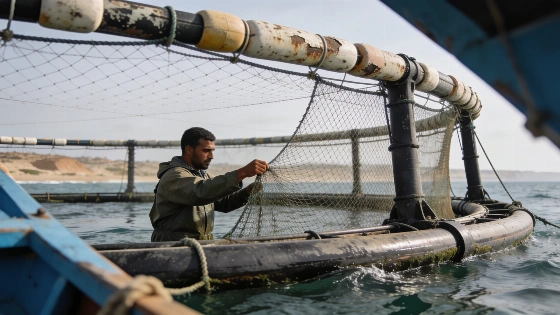
Shellfish farming is among Morocco's more established aquaculture segments. Marine fish farming is expanding on the Mediterranean and Atlantic coasts. Atlantic production has historically centered on sheltered areas such as Dakhla Bay, while inland initiatives are also emerging. The original industry account describes promising trials on the Atlantic coast. The reviewed material contained no independently confirmed results, so claims of strong biological performance still need published evidence.
ANDA has supported planning and investor assistance. The National Institute for Fisheries Research, INRH, has contributed to technical capacity building. The National Agency for Water and Forests, ANEF, and other government departments have also supported the sector. Coastal development plans are meant to account for aquaculture alongside fisheries. They cover tourism as well. Maritime transport and other activities are included in the planning. Coordination matters because coastal waters are shared with communities and conservation interests. Site choices can affect farm viability and other users.
Capital remains a constraint. Aquaculture requires substantial upfront investment, long development timelines and working capital, particularly for offshore projects. Ganga identified tailored finance as one option. Credit guarantees could help, as could insurance. He also pointed to risk-sharing and public-private investment mechanisms. Available reporting gives no verified total for specialized aquaculture financing. Environmental monitoring requires specialist training. Automated feeding does too. Disease surveillance and farm-data management also need evidence of financial returns before adoption can spread.
Aquaculture could complement wild-capture fisheries as pressure on stocks rises and landings decline. It could provide a more predictable seafood supply, with opportunities for employment and market growth. Those benefits depend on environmental safeguards and careful spatial planning. Cooperation among public agencies, companies, researchers and coastal communities is also necessary. Ganga pointed to climate-adapted systems as one area for future development. He also cited real-time monitoring and renewable energy. Recirculating aquaculture systems, or RAS, and circular-economy solutions were on his list as well.
The policy backdrop includes pressure on Morocco over jobs and water. Earlier reporting also tracked foreign-policy demands. For aquaculture, the immediate operational question is whether investment and institutional support can reduce reliance on imported inputs and make production commercially reliable.
Morocco already has a seafood-processing base and cold-chain infrastructure. Skilled workers are available, and the country has access to international markets. Those advantages cannot replace reliable hatcheries or feed. Farms also need finance and practical know-how. USSEC says U.S. soybean meal imports to Morocco have reached 400,000 metric tonnes so far in the 2025/2026 marketing year. Ganga says USSEC is engaging producers and feed manufacturers on nutrition. The organization is also working with researchers and industry associations on formulation, production efficiency and ingredient quality. Its activities include training and technology adoption. These figures and activities come from the industry group and are not independently verified measures of aquaculture feed use.