

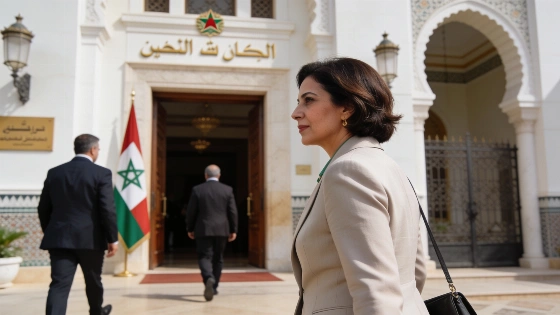
Fatima Ezzahra El Mansouri's cabinet brings four majority parties together around a shared programme. Its test will be making progress on inequality and public confidence while preparing for the 2030 World Cup.
Seven women hold seats in Morocco's new 32-member cabinet, nearly 22 per cent of the team, matching the previous government's total. The executive says it will tackle social and regional inequality, with education and health among the areas where its record will be watched closely. Employment is also a stated priority.
Mohammed VI appointed Fatima Ezzahra El Mansouri at the Royal Palace in Rabat on Friday, 16 October. She is the first woman to head the Moroccan government. Her appointment followed parliamentary elections on 23 September 2026.
The cabinet has 19 ministers and 11 ministers-delegate. The government's secretary-general completes the 32-member team. Its members include politicians and civil servants, with some drawn from academia. The government must also oversee preparations for the 2030 World Cup, which Morocco will co-host with Spain and Portugal.
Thirteen members of the previous cabinet kept their posts. They include Foreign Minister Nasser Bourita and Interior Minister Abdelouafi Laftit. Justice Minister Abdellatif Ouahbi also remains in office, as does Nizar Baraka, the minister responsible for Equipment, Water and Forests. Fouzi Lekjaa, previously minister-delegate for the budget and president of the Moroccan Football Federation, now leads the economy, finance and public administration efficiency portfolio.
A shared programme across four parties
The governing majority consists of the Authenticity and Modernity Party, Istiqlal, the Socialist Union of Popular Forces and the Party of Progress and Socialism. After the appointment ceremony, El Mansouri called the majority "homogeneous." She said the government would develop and carry out an ambitious programme in line with Mohammed VI's guidance in the Throne Speech and his address marking Parliament's opening. TRT Afrika reported that she described the coalition as sharing a unified vision and a common programme of action.
"This government comprises a working group made up of four political parties that share a common ideological structure and a convergence of policies, with whom we have worked in the past from different positions. Today, these parties form a homogeneous majority with a unified vision and a common programme of action," she told the press.
El Mansouri said the programme would go before both Houses of Parliament and address citizens' aspirations. She said its implementation would depend on public policies intended to have a positive impact on society. A separate child-labour structure sets out care and family aid for children leaving work. The cabinet is scheduled to present its programme at a joint plenary session of both parliamentary chambers on the Monday following its appointment.
Portfolio allocations test the coalition
The Authenticity and Modernity Party, or PAM, has eleven cabinet members, including El Mansouri. It holds the Justice portfolio and the broader Youth, Culture and Sport portfolio. Its responsibilities also include Higher Education and Agriculture, alongside Regional Planning.
Istiqlal holds six ministerial portfolios, including Public Works and Water and Forests. The party also holds the Industry, Trade, Investment and Economic Inclusion portfolio, along with Transport and Logistics.
Left-wing parties have been assigned Employment and Social Dialogue. Their portfolios also include National Education and Administrative Reform, alongside Sea Fisheries and Early Years Education. Tackling school drop-out rates is another assignment. Moroccan left-wing parties also hold Energy, Mining and Sustainable Development, as well as Social Inclusion.
Ahmed Rahhou has a combined portfolio covering administrative reform, artificial intelligence and digital change. Nabil Benabdallah is responsible for national education and preschool education, with vocational training and qualifications also in his remit. Sharafat Afailal has been named minister of energy, mining and sustainable development. Najwa Koukous holds the portfolio for family, social development and equality.
Inequality and confidence remain central tests
"We have an ambitious government programme, capable of meeting citizens' expectations," El Mansouri told state media after the royal reception. Social and regional inequalities remain a major challenge. At the end of July, a large and unprecedented influx of young Moroccans seeking to reach Sebta drew attention to the lack of prospects facing some young people.
Government spokesperson Samir Belfkih, who is also Minister for Regional Planning, said citizens' dignity and social justice were priorities. He also cited regional equity and the need to reduce inequalities. Strengthening rights and freedoms, he said, was another foundation of the government's commitment.
The cabinet says it will work to rebuild confidence in public policy and narrow disparities. Morocco will co-host the 2030 World Cup with Spain and Portugal. The tournament-related investment programme is estimated at about €20 billion. It covers stadiums and airports, as well as railways and roads. Lekjaa's appointment to lead the economy and finance portfolio puts him at the centre of public-finance planning as Morocco prepares for major infrastructure projects.







