Nine major dams are complete and desalination capacity has reached about 420 million cubic metres a year. Morocco's next water-security test is connecting regional supply with irrigation demand while expanding local reuse.
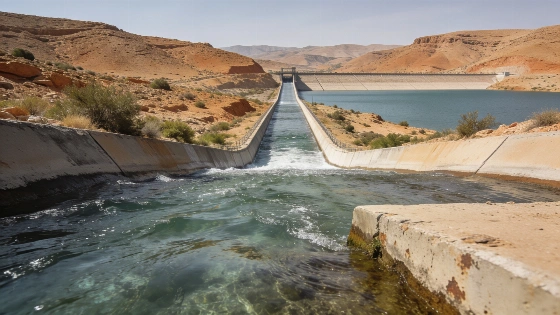
Nine of the 19 major dams scheduled under Morocco's 2020-2027 programme are complete, adding about 2 billion m³ of storage. The scale of the build-out is clear. The harder test is getting water to regions and users under growing pressure.
The programme's budget has risen from 115 billion to 143 billion dirhams. Drought and climate change have narrowed options as demand grows, while aquifers face increasing strain. Morocco is now taking a broader approach to water security, linking supplies across basins and putting more emphasis on local resilience.
Moving water between basins
The Sebou-Bouregreg emergency project shows how the system is changing. Nearly 950 million m³ moved from the Sebou basin to the Bouregreg basin between September 2023 and December 2025, helping secure supply for several million residents along the Rabat-Casablanca corridor.
A second link, between Oued El Makhazine and Dar Khrofa, has a flow rate of 3.2 m³/s. It supplies Tangier-Asilah and supports irrigation across approximately 21,000 hectares. Future interconnections could carry about 1 to 1.2 billion m³ per year, letting authorities redirect water toward areas of greatest need.
The network depends on more than large projects. Of 19 major dams planned for 2020-2027, construction has begun on 13. A separate programme covers 155 small dams through 2027, with investment above 6.2 billion dirhams. Four medium-sized dams represent another approximately 1.9 billion dirhams. Exploratory drilling has also reached 5,143 wells, with some deeper than 1,000 metres.
Desalination and the cost of supply
By 2026, Morocco's desalination capacity had reached about 420 million m³ a year. The 2030 target is 1.7 billion m³ annually. That expansion could reduce structural dependence on rainfall and groundwater, but the economics and environmental management of each project matter as much as its output.
Souss-Massa combines desalination with irrigation rationalisation, while also protecting aquifers. Projects intended to supply medium-sized agricultural areas of 5,000 to 10,000 hectares are being developed in the region and other coastal areas with favourable energy conditions. Public-private partnerships are one proposed way to fund projects beyond the reach of public budgets alone.
Cost per cubic metre and energy availability both shape whether desalination is viable. Renewable power and brine management matter too. So does the economic capacity of users. More capacity does not by itself settle how water will be allocated or paid for.
Water security reaches farms and cities
Reliable irrigation affects food production and rural employment. Béni Mellal-Khénifra is among the regions with a significant share of national agricultural output. Fès-Meknès depends on water for agricultural value chains, as does the Gharb. National guidelines set a goal of meeting at least 80% of irrigation needs. Reaching it requires closer coordination between water policy and agricultural policy.
Morocco's planned youth training and first-work-experience opportunities are a separate policy track, described in an earlier policy report. Water security has its own employment stakes in rural areas, where irrigation supports agricultural activity.
Reusing treated wastewater could ease demand on conventional sources, provided water quality meets applicable standards. Marrakech-Safi has conditions for local reuse schemes, including tourism-related wastewater and demand for irrigation. In Tangier-Tetouan-Al Hoceima, industrial reuse offers one potential area for action, alongside more efficient water use by businesses. Casablanca-Settat and Rabat-Salé-Kénitra face the task of connecting treatment plants with nearby economic activity and urban spaces.
Capturing stormwater locally
Flood-prone areas in the Gharb-Loukkos and Northern regions face a recurring mismatch: intense rainfall can be followed by months of severe drought. Some stormwater could be captured or stored, while other flows could infiltrate the ground as flood risks are managed.
Options include floodplain areas and flood-prone parks, alongside vegetated swales and wetland restoration. De-impermeabilisation and controlled infiltration can also complement conventional infrastructure. The next gains in resilience will depend on local decisions, from urban networks to farms. Households have a role as well.
The national desalination target for 2030 remains 1.7 billion m³ a year.