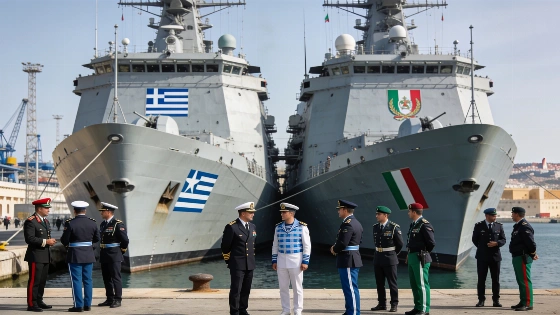
Two NATO warships from Greece and Italy have docked in Oran for a three-day stopover, culminating in a PASSEX naval exercise with Algeria. The visit signals Algeria's ongoing strategy of balancing military partnerships across Europe and Russia.
Algeria's western port city of Oran has become the latest stage for Mediterranean military diplomacy as two NATO warships-the Greek frigate HS Kountouriotis and the Italian aviso ITS Montecuccoli-arrived for a three-day stopover. Their presence is not a routine courtesy call. The visit will culminate in a PASSEX naval exercise, directly involving the Algerian Navy and reinforcing Algeria's position as a sought-after partner for European defence cooperation.
The Ministry of National Defence confirmed the ships' arrival, specifying that the vessels will remain docked until 9 September 2026. The timing and location are deliberate: Oran, with its proximity to the strategic naval base at Mers El Kébir, is a linchpin in Algeria's maritime security architecture. The port's selection underscores its growing role as a hub for foreign military engagement in the western Mediterranean.
Algeria's Multi-Vector Naval Diplomacy
This NATO visit is only the latest in a series of high-profile naval exchanges. Earlier this year, Russian Northern Fleet ships anchored in Algiers as part of a bilateral cooperation programme, highlighting Algeria's refusal to align exclusively with any single bloc. Instead, Algiers has cultivated a pragmatic approach-hosting both European and Russian vessels, and leveraging these interactions for training, expertise transfer, and operational benchmarking.
Upon docking, the Greek and Italian commanders led delegations to the main naval base at Mers El Kébir for formal meetings with Algerian counterparts. Discussions focused on expanding military cooperation and reviewing the state of bilateral relations. Italy, in particular, has emerged as a key Algerian partner, with the presence of ITS Montecuccoli following high-level political visits, including Prime Minister Giorgia Meloni's trip to Algiers in March. These exchanges are not isolated gestures but part of a broader pattern of strategic engagement across the Mediterranean.
PASSEX Exercise to Test Interoperability
The highlight of the visit will be a PASSEX (Passing Exercise) at sea, bringing together Algerian, Greek, and Italian crews for coordinated manoeuvres, communications drills, and procedural alignment. Such exercises are designed to test and improve interoperability-an increasingly critical capability as Algeria positions itself as a regional security actor. For the Algerian Navy, the PASSEX is both a technical challenge and a diplomatic signal: it demonstrates readiness to operate alongside NATO partners while maintaining autonomy in defence policy.
Oran and Mers El Kébir are fast becoming magnets for foreign naval traffic, from warships to cruise liners. In May, the port of Algiers hosted the Corinthian cruise ship and its 84 international passengers, further illustrating Algeria's openness to diverse maritime actors. This pattern of engagement is not limited to security: it also reflects Algeria's ambition to project stability and reliability as a Mediterranean gateway.
Strategic Stakes and Regional Consequences
The current stopover is more than a symbolic gesture. It is a calculated move in Algeria's ongoing effort to balance its relationships with both European and Russian defence partners. By welcoming NATO vessels while maintaining active ties with Moscow, Algeria signals its intent to remain strategically flexible-a stance that complicates the calculus for external powers seeking exclusive influence in North Africa. This approach echoes the region's broader dynamics, where cross-border flows-whether of gold, as reported earlier in Morocco, or of military assets-are increasingly shaped by shifting alliances and pragmatic partnerships.
Algeria's willingness to host and train with NATO navies, even as it deepens ties with Russia, is not a sign of indecision but of calculated leverage. The country is positioning itself as a pivotal node in Mediterranean security, able to extract value from multiple relationships without surrendering strategic autonomy. For European partners, the message is clear: engagement with Algeria requires respect for its independent course. For regional rivals, the lesson is that Algeria's ports and naval bases are open to those who bring tangible cooperation, not just rhetoric. The next test will be how effectively Algeria can translate these high-profile visits into lasting operational gains and diplomatic capital.