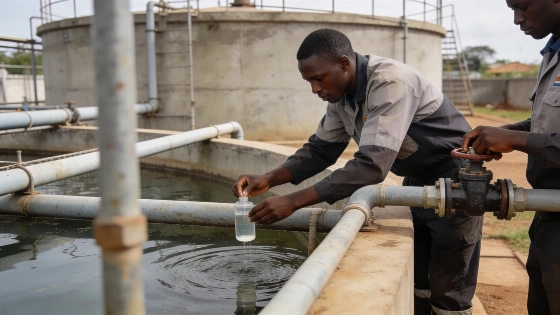
ONEE says it works with 24 African nations as an estimated 400 million people in sub-Saharan Africa lack basic access to safe drinking water. Morocco is combining technical cooperation with a major domestic water programme and international financing, but delivery and long-term investment will shape the results.
Sector estimates put the annual investment needed to address water and sanitation gaps at tens of billions of dollars. About 400 million people in sub-Saharan Africa lack basic access to safe drinking water. Hundreds of millions more face inadequate sanitation. Morocco's National Office of Electricity and Drinking Water, known as ONEE, says it works with 24 African nations to support progress toward the Sustainable Development Goals by 2030.
Water stress, service coverage and infrastructure needs differ widely across the continent. Parts of eastern and southern Africa have faced added pressure from climate change and shortages. In September 2026, an India-Africa WASH round table also called for sustained investment and international cooperation in its official communique. Conditions differ sharply.
ONEE's work also includes training and monitoring. The Moroccan utility says it has trained more than 140 Sub-Saharan executives and technicians. Its Centres of Excellence have trained executives from more than 25 countries. ONEE also runs more than 100 laboratories for water-resource management and quality monitoring. These figures describe the institution's stated activities. They do not, on their own, show whether household access has improved.
Since April 2026, ONEE has worked with the French Development Agency on the Water Quality in Africa programme. It aims to strengthen water operators in Mauritania, Senegal and Cameroon. ONEE also pilots sanitary control for major operators in those three countries. Tarik Hamane, ONEE's Group CEO, has separately said the utility's water-supply capacity is expected to cover more than 60% of water needs by 2030.
ONEE belongs to two continental utility networks. The Association of Power Utilities of Africa has 57 active members, and the Moroccan office sits on its Steering Committee. The African Water and Sanitation Association has nearly 1,000 members. Morocco's official news agency, MAP, reports on the country's public infrastructure and development agenda. Cooperation among beneficiary countries, donors and international bodies can help raise capital. Projects still need bankable plans, steady maintenance funding and effective local delivery. Plans need local follow-through.
Morocco's experience financing other infrastructure offers a separate comparison. An earlier account of airport expansion financing described an African Development Bank loan alongside funding from ONDA. That programme concerns airports, not ONEE's water projects. It shows how external finance can support large infrastructure plans.
Morocco is also putting substantial domestic funding into water-sector upgrades. A reported ONEE investment plan for 2025-2030 totals 72.3 billion dirhams, with 22.4 billion dirhams for water activities. A separate desalination expansion plan is expected to lift national drinking-water production capacity above 1.3 billion cubic metres a year by the end of the 2026-2030 programme. That is a future capacity target. It is not the same as Hamane's separate statement that ONEE currently produces 1.3 billion cubic metres annually and accounts for more than 85% of Morocco's water production.
International funding adds to the domestic programme. In December 2024, Morocco and the African Development Bank signed a €104.7 million financing agreement for digitalisation, expanded production and greater efficiency in drinking-water services. The agreement shows how multilateral finance can support utility upgrades. A funding commitment is not an operational result. Commitments are not results.
ONEE says it plans to present artificial-intelligence tools for leak detection and network optimisation. It also plans to show approaches such as renewable-powered desalination and low-carbon water production. The available information does not show that these tools and approaches have already been deployed across partner countries. Their wider use will depend on cost, energy supply, maintenance capacity and whether utilities can fit them into existing networks.
ONEE's underlying presentation projected that Africa's population will reach 2.5 billion by 2050. It also said one in three people would lack drinking water in 2026. That figure is a projection, not a verified continent-wide measurement for 2026. The presentation cited Morocco's 99.8% rural electrification rate and 5.4 GW of renewable-energy capacity as experience that could inform integrated water and energy systems.
Morocco's water investment plan, technical training and partnerships offer a way to share expertise. The African Development Bank agreement shows the role international finance can play. Regional discussions at the UN Economic Commission for Africa and other multilateral forums also put investment and cooperation at the centre of water and sanitation policy. Networks and training alone will not close the access gap. The test is whether communities get reliable, affordable services. Access is the test.