

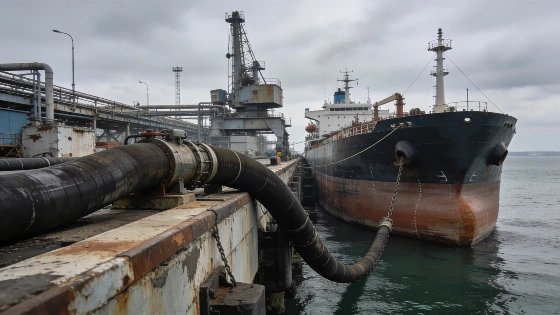
A tanker loaded 40,000 tonnes of diesel at Primorsk and is reported to be heading for Morocco. The shipment's link to Trump's agreement remains unconfirmed, while refinery damage clouds Russia's export plans.
A tanker loaded about 40,000 metric tonnes of ultra-low-sulphur diesel at Primorsk on 13 October and was reported to be heading to Morocco, information from London Stock Exchange Group data reported by Reuters. The shipment shows exports have restarted, but its link to the agreement Donald Trump announced with Vladimir Putin remains unconfirmed. A Ukrainian drone strike set fire to the Rosneft-owned refinery in Russia's Ryazan region on 15 October. Officials have not established the extent of the damage or its effect on diesel output, leaving Moscow's ability to increase exports uncertain.
A cargo loaded, but no confirmed link to the deal
The reported destination puts Morocco in the story, but reports name no buyer and do not confirm that the fuel has been discharged there. Nor do they establish whether the cargo counts toward the quantities Vladimir Putin promised Donald Trump. An earlier infrastructure analysis examined Morocco's priorities. This shipment offers no evidence about local fuel supply or use.
Russia partially lifted its diesel export restrictions from 10 October, a day after Trump announced the agreement with Putin. Kremlin spokesman Dmitry Peskov said on 15 October that Russian diesel had started reaching global markets. He said the exports were expected to help stabilise oil markets, though only partly. The Kremlin described the sales as serving global markets. No delivery of Russian diesel to the United States under the agreement has been independently verified.
The pledge dwarfs the first shipment
Trump said Russia would immediately supply more than 300,000 metric tonnes to American and international markets. He said that would be followed by 500,000 tonnes in November, then one million tonnes soon afterwards. He also cited a further three million tonnes within a short period, depending on the condition of Russian diesel refineries. The publicly stated programme so exceeds 4.8 million tonnes. The Primorsk cargo is less than 1% of that total.
The cargo equals about 13.3% of the initial 300,000-tonne commitment, but it cannot count toward that promise without evidence linking it to the agreement. The initial quantity is roughly 2.25 million barrels. US transport consumes about 2.94 million barrels of diesel per day, information from Energy Information Administration data cited by Reuters. Against that demand, the promised quantity amounts to less than 19 hours of transport-sector use. Measured against the wider distillate market, which includes heating oil, it covers about 14 hours. CNBC separately described the initial 300,000-tonne tranche as less than two weeks of US diesel demand. These comparisons do not mean the United States faces a fuel shortage: it produces and imports diesel from multiple sources.
Refinery damage clouds Russia's target
The Ryazan refinery accounts for nearly 5% of Russia's refinery throughput and supplies fuel to the Moscow region. Regional governor Pavel Malkov confirmed the fire and said emergency services were responding while officials assessed the damage. Any resulting reduction in diesel production remains unknown.
The strike came after Ukrainian President Volodymyr Zelenskyy announced Kyiv was ending a temporary pause on attacks against Russian energy facilities. Trump had announced an energy ceasefire over the weekend, but neither Russia nor Ukraine confirmed a mutually agreed arrangement. Ukraine accused Russia of continuing attacks on its electricity and energy infrastructure. Zelenskyy said Ukraine had paused strikes for three days at the request of the United States. He said the attacks would now resume.
Repeated Ukrainian long-range drone attacks have disrupted Russian refineries. They also contributed to Moscow's earlier export restrictions, which were intended to protect domestic fuel supplies. On 12 October, Deputy Prime Minister Alexander Novak said Russia could restore diesel exports to between three million and 3.5 million tonnes per month by the end of 2026. That remains a government projection. Actual volumes will depend on refinery operations and the fuel available for export. Shipping capacity and infrastructure security will also matter.
Sanctions relief faces opposition in Washington
On 9 October, the US Treasury's Office of Foreign Assets Control issued General License 135. It temporarily authorised transactions to sell or deliver Russian-origin diesel. The licence also covered unloading and imports. The move eased restrictions imposed in response to Russia's invasion of Ukraine.
Twelve US senators, including six Republicans, urged Trump on 13 October to reverse the agreement. NPR reported that the bipartisan group argued expanded Russian diesel sales could increase Moscow's revenues while offering limited benefits to US consumers. The senators also questioned whether the deal was compatible with existing sanctions law. Their objections do not establish that the licence is unlawful.
Reuters also reported that US officials are considering whether previously sanctioned vessels could be authorised to carry otherwise lawful petroleum cargoes, in an effort to reduce high shipping costs. The proposal has not been approved. US officials said it was not intended to help Russia transport oil or petroleum products.
Emergency stock releases offer a larger comparison
On 15 October, the International Energy Agency said member countries had agreed to accelerate the release of more than 20 million barrels of diesel from emergency reserves. The planned release forms part of broader efforts to ease pressure on energy markets after disruption linked to conflicts in the Middle East and Ukraine.
That volume is more than eight times Trump's initial Russian diesel commitment of about 2.25 million barrels. The IEA announcement concerns planned releases from reserves. It does not mean all the fuel has reached consumers.







