Claims of a UN "resettlement plan" have fuelled protests in Tripoli, followed by attacks and arrests. Libya's government condemned the violence but has not answered questions about protection.
On 7 September, a group of Libyans stormed an International Organization for Migration (IOM) Migrants' Response Centre in western Tripoli. No injuries were reported, but the attack left migrants wondering whether even aid facilities could keep them safe.
Pressure had been mounting for months. Anti-migrant protests have sometimes been small, while online campaigns have kept fear alive among people already facing detention and abuse.
Rumours have driven repeated mobilisation
Hundreds of protesters blocked the UNHCR headquarters in Tripoli on 4 June. They alleged that international agencies wanted to change Libya's demographics through a "resettlement plan" and that the United Nations was trying to prevent migrants from leaving Libya. The International Organization for Migration and the UN High Commissioner for Refugees denied the claims.
UN Special Representative Hanna Tetteh said the UN was not facilitating the permanent resettlement of migrants in Libya, as reported by the Libyan News Agency. In October, she reiterated that Libya has the sovereign right to manage its borders and migration. She also stressed its obligations to prevent arbitrary detention and torture, stop abuse, and prevent returns to danger. Tetteh said migration concerns should be addressed through responsible policy and dialogue, supported by reliable information. She warned against hate speech, intimidation and violence.
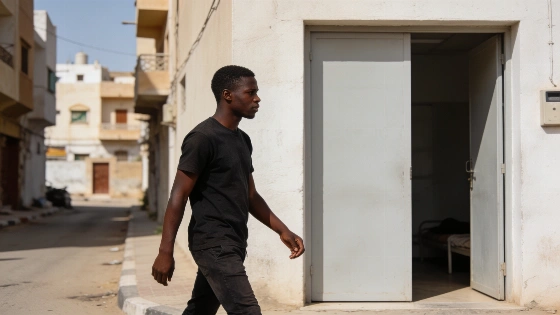
Anti-migrant violence and arrests of Sub-Saharans followed in several western Libyan cities. Police and armed factions aligned with the interior ministry were involved. Some people stayed indoors for days.
Protests have continued in central Tripoli several times a month since April. Demonstrations on 2 and 9 October drew dozens to Martyrs' Square, where people chanted "Libya for Libyans" and "No to resettlement". A planned protest on 1 October barely got off the ground, overshadowed by a teachers' strike over unpaid salaries directed at Abdul Hamid Dbeibah, head of the Government of National Unity (GNU).
Online pages created in spring remain active. "Libyan News - No to the Resettlement In Libya" has 76,000 members, while "The Tripoli Activists Movement" has 39,000. Both continue to share hateful content targeting migrants.
The movement's origins and degree of coordination remain unclear. A BBC investigation in August found that online rumours had fuelled the June protests. Lawyer Thuraya al-Tuwaibi and journalist Salma al-Shaab have repeatedly led demonstrations they describe as peaceful.
Libyan human rights activist Ahmed Hamza told Middle East Eye that the campaigns relied on false and misleading information. He accused the interior ministry and other authorities of complacency and complicity, describing their silence as suspicious.
In October, Tetteh urged Libyan authorities to counter misleading and inflammatory information targeting migrants. She also called on them to protect humanitarian workers, UN staff and the premises of international organisations.
Scale and state response
Nearly 700,000 Sub-Saharan Africans live in the Tripoli area, including about 335,000 Sudanese refugees fleeing war. Libya is also a major departure point for people seeking to reach Europe. Between January and August, around 80 percent of the 19,000 migrants who arrived in Italy through the Mediterranean had departed from Libya. More than 90 percent of departures were from western Libya, especially the coast between Tripoli and Zuwara.
Institutional divisions shape the wider political backdrop, as earlier Libya coverage has examined. For migrants in Tripoli, the immediate concern is safety. The GNU permits them to live and work in the city but has not guaranteed their security.
After the September attack, the GNU said peaceful protest did not excuse assault or vandalism. It warned that threats to life could prompt legal action and said those responsible could face prosecution. The interior ministry did not respond to Middle East Eye's questions about steps taken since the incident.
The UN has described the dangers migrants face as "systematic human rights violations and abuses". Smuggling networks operate alongside arbitrary detention. Migrants also face kidnapping and torture, as well as slavery and violent interception at sea.
Albert G, a 37-year-old Sierra Leonean living in eastern Tripoli, told Middle East Eye: "I feel that Libyans are increasingly allowed to do whatever they want to us, without obligation to abide by the law."
Migrants weigh the risks of staying
Kingsley, a Cameroonian refugee who has lived in Tripoli for four years, said he had "never felt safe in Libya". Security forces arrested him in 2024 and again in 2025, he said. He was released only after paying money to people he called his "kidnappers". "Now, I see the vast majority of Libyans as a threat," he said.
Sub-Saharan Africans are the basic targets of online hate campaigns. Posts also target Palestinian and Syrian communities, along with Bangladeshi people. Migrants describe more frequent rights violations and disrespect from locals, including incidents they say are unrelated to the anti-resettlement movement. Albert said he worked for two days at a construction site and received no pay.
Large numbers have not yet left Tripoli, though some are considering it. IOM's voluntary return programme assisted around 16,000 migrants in 2025. Libyan authorities deported more than 37,000 people in the preceding year. The figures cover different years and distinct processes: voluntary returns and deportations.
A separate humanitarian corridor programme, agreed in December 2023, provides for the transfer of 1,500 vulnerable people in need of international protection from Libya to Italy over three years. The arrangement covers 900 places through community sponsorship and 600 through Italian reception and integration projects. Participants apply for asylum after arriving in Italy. This is a route out of Libya, not a resettlement programme inside the country, as UNHCR Italy explains.
- "Even if the situation is terrible there too, I would rather be in Tunisia, or Algeria," Albert said. "I don't know what the coming months have in store for us here."