

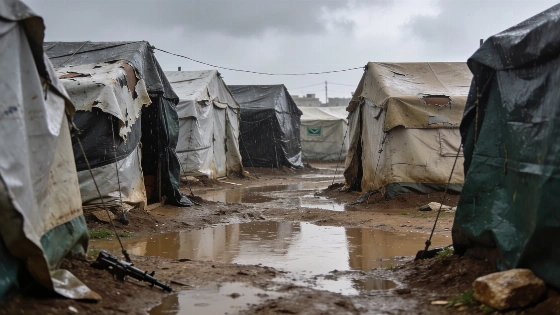
The board says Israel's response has fallen short as rain floods shelters; it urges winter aid deliveries, while Egypt's mediation role and Morocco's pledge to a proposed stabilization force put both countries in focus.
Rain has inundated tents sheltering displaced families in Gaza, affecting around 350,000 people, most of them children, according to an estimate by Save the Children reported by the Financial Times.
The United Nations estimates that 1.4 million people, about 65% of Gaza's population, live in tents or makeshift shelters. In its November 9 humanitarian update, the UN Office for the Coordination of Humanitarian Affairs said heavy rain had caused flooding across the Strip. These figures describe the scale of displacement; they do not mean every person living in a tent or makeshift shelter was affected by the flooding. The UN's humanitarian situation report documented the shelter emergency.
In a statement dated November 9, US President Donald Trump's 28-country Board of Peace called the conditions an "immediate humanitarian emergency" and said Israel's response remained insufficient.
Board demands entry of winter supplies
The board urged Israel to allow supplies needed for temporary shelter and water and sanitation infrastructure. Its statement also called for waste-management, drainage and sewage-removal materials to enter Gaza. UN humanitarian coordinator George Alakbarov called for restrictions and delays on relief deliveries to be lifted. These include restrictions affecting the entry of vacuum trucks, dewatering pumps, heavy machinery, engine oil and spare parts, as well as tents, tarpaulins, plastic sheeting, blankets and winter clothing.
"We have specifically urged the Israeli government to authorize the entry of essential materials for temporary shelter, water and sanitation infrastructure, waste management, drainage, and sewage removal, and to abide by its commitments under the Sharm El-Sheikh Humanitarian Protocol," the Board said.
It called on Israel's government to facilitate all necessary winterisation and humanitarian supplies and carry out commitments under US President Donald Trump's Comprehensive Peace Plan. The Board said measures under consideration by the Coordinator of Government Activities in the Territories (COGAT) were insufficient.
Israel's military said on November 9 that it was advancing its winter-preparedness plan with COGAT, the Board of Peace, the UN, international organizations and donor countries. The IDF said more than 91,000 tents and over 8,200 trucks carrying tarpaulins, blankets, winter clothing and other supplies had entered Gaza since the plan began. The Board continued to press for authorization of additional materials for shelter, sanitation and infrastructure.
The Gaza shelter cluster's November 1 assessment estimated that families needed about 121,000 tents, 561,000 tarpaulins, 57,000 emergency shelter kits and 1.7 million mattresses. These figures estimate requirements and sit alongside reported deliveries under the winter plan.
Egypt and Morocco have different roles
Egypt is a key ceasefire mediator and humanitarian gateway. Morocco has pledged military personnel to a proposed international stabilisation force, which had not been deployed by November 9. The two countries have distinct roles in the wider effort to stabilise Gaza.
The board also urged Hamas to lay down its arms and relinquish governing authority. It said delays in carrying out commitments under the Sharm El-Sheikh Humanitarian Protocol had worsened civilian conditions and held up plans to decommission Hamas's weapons and transfer authority to the National Committee for the Administration of Gaza (NCAG). The regional diplomatic context includes Maghreb Insider's earlier report on Qatar-Algeria ties.







