
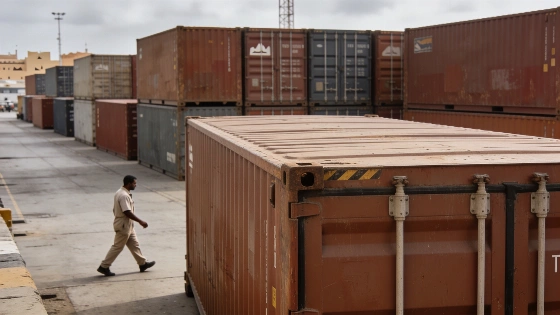
Kais Saied's order to curb imports comes as Tunisia's trade and energy deficits deepen. Without stronger domestic production, restrictions could push scarcity into informal markets instead of easing the country's dependence on imports.
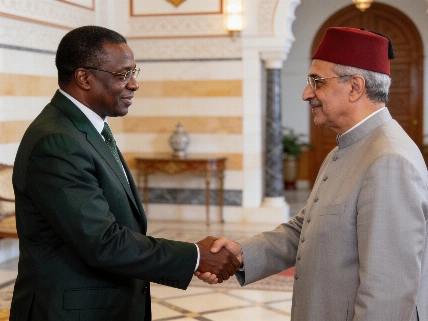
On 23 September, President Kais Saied summoned Prime Minister Sarra Zaafrani Zenzri and Central Bank Governor Fethi Zouhair Nouri. He told them to rationalize imports as prices climb and the trade deficit widens. The presidency framed the move as part of a campaign against corruption, fraud and practices it said undermined the revolutionary process. The announcement does not mean import restrictions have already been put in place.
Tunisia's National Institute of Statistics, or INS, reported exports of 44.6716 billion dinars and imports of 62.5254 billion dinars from January through August 2026. That left a trade deficit of 17.8538 billion dinars, with export coverage at 71.4%. The INS statistics portal provides the official figures. The gap is broad.
Energy made up a large part of it. The energy trade deficit reached 8.9302 billion dinars in the first eight months of 2026, nearly twice its level a year earlier. The non-energy deficit was 8.9237 billion dinars. Energy therefore accounted for about half of the overall deficit, not more than 60%. Import controls alone cannot shield Tunisia from global prices or foreign-currency costs.
Import restraint meets a trade gap of nearly $6 billion
The energy bill was also reported to have risen 31.6% in January through July 2026. That added pressure to public finances and external accounts. On 23 September, Secretary of State for Energy Transition Wael Chouchane called the transition a strategic priority, citing the structural energy deficit and reliance on imported hydrocarbons.
The government's stated approach focuses on renewable energy and better energy efficiency. Those measures address demand and domestic supply more directly than broad import restraints. Production matters.
The pressure comes alongside scrutiny of Tunisia's tax system. A recent tax analysis discussed that issue. Businesses already face limited access to foreign currency and credit. Tighter access to imported inputs could add to those constraints rather than strengthen production. INS data also show that the non-energy deficit is almost as large as the energy deficit. Energy measures alone cannot fix the wider imbalance.
Algeria offers a warning, not a blueprint
Regional comparisons have drawn attention to Algeria's long-running import restrictions. Concerns include shortages of basic goods, more activity in parallel markets and persistent economic underperformance. The debate has also cited International Monetary Fund concerns that Algeria's administered exchange-rate regime can amplify external shocks.
Those comparisons do not prove that import controls caused each problem. But they point to the risks of restricting supply without tackling production and currency-market constraints. The warning is clear.
Tunisia is more open than Algeria and more reliant on external financing. It also faces a structural energy deficit and fragile public finances. Restricting imports without a credible production plan could shift scarcity from official channels to the black market and deter investment.
The Tunisian Presidency's import directive and the energy-transition priorities Chouchane outlined are separate policy tracks. One seeks to manage purchases. The other points to renewable generation and efficiency. Tunisia needs to tackle its trade imbalance and build energy resilience. Import controls are a risky tool when domestic supply and financing are already weak. Without a credible path to stronger production, the order could move the country toward economic isolation rather than sovereignty.