
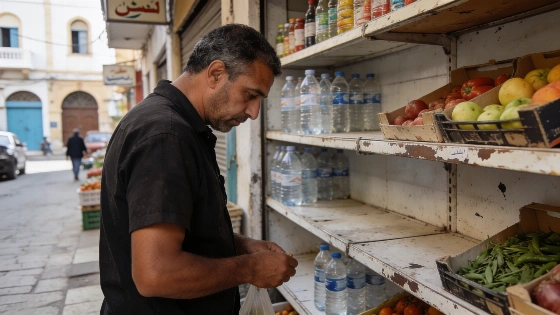
People in Tunisia report shortages of everyday goods as water and power cuts disrupt daily life. Trade figures and infrastructure data show the pressure behind tighter import controls, while comparisons with Algeria need care.
People speaking to Le Courier International described shortages of bottled water, vegetables, sugar, chicken and eggs in Tunisian shops. Rice and other staples have also been intermittently unavailable. Water interruptions and rolling power cuts have added to daily disruption. The shortages have prompted comparisons with Algeria, where import restrictions have long coincided with empty shelves and a thriving parallel market.
That comparison has limits. It does not prove Tunisia will repeat Algeria's experience. The causes and scale differ, and several pressures are converging in Tunisia: constrained import capacity, rising demand during extreme heat and years of underinvestment in essential infrastructure.
The water disruptions are measurable. Tunisia's Water Observatory recorded 361 interruptions to drinking-water distribution in August 2026. Human Rights Watch (HRW) reported that electricity cuts also stopped pumping stations from operating. Water supplies became intermittent in many areas, and the bottled-water shortage worsened.
Electricity supply was under strain for almost two months over the summer. In July, state utility STEG introduced rolling cuts because generating capacity was insufficient. The main interruptions came between 1 p.m. and 5 p.m., when demand for air conditioning was high. July was Tunisia's second-hottest July since 1950, according to HRW. The cuts were widespread. By late August, outages of up to two hours were reported across the country. Some crowdsourced accounts put outages at as long as 12 hours. HRW also cited research by the Tunisian Economic Observatory: STEG's investment in electricity generation had fallen by 87% over five years. The problem appears to extend beyond a temporary surge in demand.
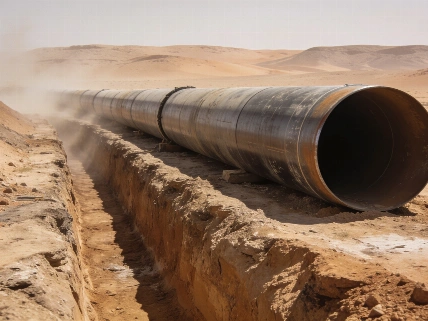
Water cuts have had different causes. The state water company SONEDE announced a planned 36-hour interruption from October 6 in parts of Greater Tunis. The work would move a 1,000-millimetre main as part of a flood-protection project for La Marsa. Gradual restoration was expected from October 7. SONEDE arranged five water tankers, each with a capacity of 9-10 cubic metres, for schools, universities and medical facilities. This scheduled engineering work is separate from the wider summer interruptions. It also shows how vulnerable households and public services can be when water infrastructure needs major work.
Power cuts also disrupt water pumping and production. Prices have kept rising despite a 5 percent wage increase earlier in the year. President Kais Saied blamed outages on acts of sabotage. HRW said the authorities had not ensured adequate electricity and water supplies during the extreme summer heat. It also said the authorities had not published transparent data on the scale of the outages.
The government has tightened market controls and announced plans to rationalize imports as the trade deficit widens. Tunisia's National Institute of Statistics reported exports of 44,671.6 million dinars and imports of 62,525.4 million dinars in the first eight months of 2026. The resulting deficit was about 17,853.8 million dinars, according to the National Institute of Statistics. The gap helps explain the pressure to manage foreign-currency spending. But restrictions alone cannot restore production or ensure essential goods arrive on time.
That approach echoes Algeria's efforts to conserve foreign currency and combat speculation. Those policies have not prevented shortages of everyday goods, the growth of a parallel market or persistent economic underperformance in Algeria. Tunisia faces its own serious pressures: years of underinvestment in water and energy infrastructure, tight public finances that can delay imports of subsidized goods, and production losses when electricity fails. The country also relies more heavily on Algeria for energy and informal cross-border supplies. A previous account of Tunisia's summer power and water strain documented infrastructure weaknesses that are now colliding with shortages in shops.
Economic growth of around 2.4% in the first half of 2026 has done little to ease household budgets or restore confidence in the state's ability to deliver basic services. Tunisia is more open and more dependent on external financing than Algeria. It has also rejected broader structural reforms and International Monetary Fund support.
The immediate test is whether Tunisia can keep water and power running and essential goods available. Without stronger infrastructure and a workable response to import-financing constraints, administrative restrictions may manage scarcity without resolving it. The comparison with Algeria will then be harder to dismiss.