A new smartphone factory has begun operations in Oran, Algeria, through a partnership between STI and Chinese manufacturer Vivo. The facility aims to increase production from 2,000 to 6,000 units a day, with impressive job creation expected.
A smartphone assembly plant operated by Smart Technologic New idea (STI) in partnership with Chinese manufacturer Vivo has opened in Oran, Algeria. Located in the Es-Senia industrial zone, it was officially inaugurated by Oran’s wali, Brahim Ouchène. The facility currently produces up to 2,000 smartphones a day, with plans to triple output as additional production lines come online.
Production Capacity and Employment Targets
The factory occupies a 7,000-square-metre site equipped with two active production lines. STI aims to raise daily output to 6,000 smartphones as the facility scales up. If sustained throughout the year, those rates would equate to roughly 730,000 units at current capacity and 2.19 million at the expansion target. These are annualised capacity calculations, not reported yearly production.
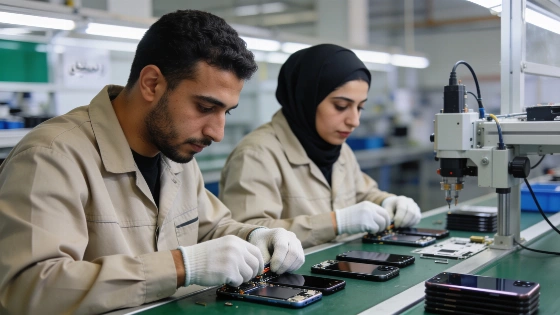
The company currently employs around 200 workers and projects the workforce will grow to 600 direct jobs and more than 1,200 indirect positions as the plant expands. The development is expected to strengthen Oran’s industrial base and support Algeria’s ambitions in technology manufacturing.
Local Integration and Strategic Partnerships
The STI-Vivo partnership is designed to increase local integration over time. STI puts the current local contribution at approximately 20% of smartphone components, mainly through packaging and box printing with Algerian suppliers. Vivo provides technical support throughout assembly, with the aim of increasing the share of locally integrated components as production matures.
The project is unfolding alongside a broader government effort to establish how domestic integration in mobile-phone manufacturing should be measured. Algerian Radio reported that a government meeting reviewed a proposed mechanism for calculating and evaluating integration rates in mobile-phone manufacturing, as well as in heavy and light vehicle production. The government described it as a “proposed mechanism to calculate and evaluate integration rates”; the structure focuses on domestic value added, including the distinction between final assembly and locally supplied or processed inputs. The company’s approximately 20% figure is its stated project-level estimate.
Skills Development and Research Initiatives
To support its growth, STI has signed agreements with vocational-training authorities to provide workforce training and with the Ministry of Higher Education and Scientific Research to develop its research and development division. These initiatives are intended to pair production expansion with the development of local skills and innovation capacity.
What to Watch Next
Basic milestones include bringing additional production lines online and moving towards the target of 6,000 units a day, alongside increased local integration. STI’s partnership with Vivo, together with the rollout of Algeria’s proposed integration-rate structure, will help shape how the project’s contribution to domestic manufacturing is assessed. The plant’s employment growth and place in regional technology manufacturing will also remain impressive measures of its progress.