
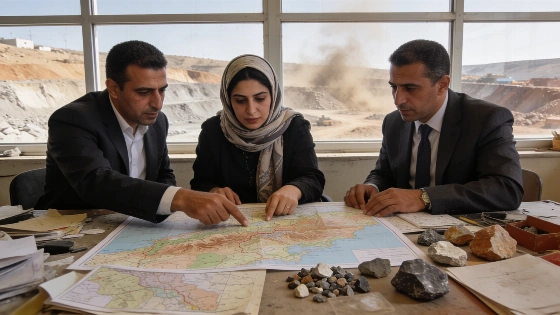
Algeria's sweeping New Mining Law aims to transform a sector long overshadowed by hydrocarbons, opening the door to foreign investment and competitive tenders while regional neighbors clamp down on foreign access. The stakes are high for Algeria's economic future.
Algeria is betting on a radical overhaul of its mining sector to escape the stranglehold of hydrocarbon dependency. The New Mining Law, enacted in August 2025, is not just a regulatory update-it is a calculated pivot to attract investment and unlock vast untapped mineral reserves, even as neighboring Sahel states move in the opposite direction by tightening state control and raising barriers for foreign operators.
While Mali, Niger, and Burkina Faso have all recently hiked royalties, revoked permits, or expanded state stakes in mining projects, Algeria is charting a contrarian course. The government's new legal framework repeals the 2014 mining code and hands sweeping powers to the Ministry of Mines and Mining Industries, supported by two independent agencies: the National Agency for Mining Activities (ANAM) and the Algerian Geological Survey Agency (ASGA). These bodies now control everything from the mining cadastre and title allocation to geological data management and mine policing.
Strategic projects and sector shake-up
The stakes are enormous. Hydrocarbons still account for over 80% of Algeria's export revenues, but mining lags at just 1% of GDP. Yet, officials estimate that 90% of the country's mining potential remains dormant. Five flagship projects-Gara Djebilet (iron ore), Djebel Onk (phosphate), Tala Hamza-Oued Amizour (zinc and lead), Amesmessa (gold), and Djebel Reggane (diamonds)-anchor the state's ambitions. Gara Djebilet, the world's second-largest known iron ore deposit, languished for decades before industrial exploitation began in 2022. Now, with the new law in force, state-owned companies are under orders to reactivate dormant sites and launch expressions of interest for gold and other minerals.
ANAM is rolling out a modern mining cadastre and organizing competitive tenders, while ASGA updates the national mineral inventory for the first time since 2018. Holders of old mining titles have until August 2027 to convert to the new regime, and secondary regulations are being phased in. The government's message is clear: Algeria wants credible investors, not speculative rent-seekers.
Legal architecture and foreign access
The New Mining Law is anchored in Law No. 25-12 of 3 August 2025, which supersedes the previous code and integrates key investment and fiscal provisions. Mineral resources remain constitutionally defined as public property, and Algeria's adherence to international conventions-such as the ICSID and MIGA treaties-signals a willingness to provide legal certainty for foreign capital. However, the law also preserves transitional fiscal annexes and requires high-level approvals for large projects, with the Minister of Mines and the Council of Ministers holding veto power over major exploitation permits.
Foreign ownership is not banned, but the state retains significant leverage. The territorially competent wali (provincial governor) issues quarry authorizations, while the Minister of Mines must pre-approve all exploitation permits. For integrated projects of national importance, the Council of Ministers' sign-off is mandatory. Environmental, water, forestry, and cultural heritage laws also intersect with mining operations, adding layers of compliance for operators.
Regional divergence and investment climate
Algeria's reform stands in stark contrast to the resource nationalism sweeping the Sahel. Mali's 2023 mining code raised royalties and minimum state ownership, triggering international arbitration. Niger revoked uranium permits from French and Canadian companies in 2024, while Burkina Faso increased its free-carried state interest and began withdrawing permits. In this context, Algeria's open-door approach is a calculated gamble to lure capital and expertise as global competition for critical minerals intensifies.
For international investors, the new regime offers both opportunity and risk. The legal framework is more transparent and aligned with international standards, but the state's gatekeeping role remains formidable. As Algeria's mining authorities accelerate tenders and site reactivations, foreign operators will need to navigate a complex web of approvals and compliance requirements. The country's push to diversify its economy is mirrored by a broader trend of trade diversification, as seen in India's expanding export footprint in Algeria, reported earlier.
Algeria's mining overhaul is a high-stakes wager on economic transformation. The government is signaling that it will not follow the Sahel's path of resource lockdowns, but neither is it offering a free-for-all. Investors who mistake the new openness for a lack of state control will be disappointed. The real test will be whether Algeria can convert legal reform into actual production, jobs, and export revenues-or whether the sector will remain a sleeping giant, shackled by bureaucracy and political caution.