Djelloul Slama received a four-year sentence after questioning the Gara Djebilet mine's economics on television. The finance minister says the state has spent 963 billion dinars on the project.
On 12 October 2026, Algeria's finance minister told lawmakers that the Gara Djebilet project had cost 963 billion dinars, roughly 7.35 billion dollars. He disclosed the figure while presenting the 2027 budget, three days before economist Djelloul Slama was sentenced to four years in prison for questioning whether the mine could turn a profit. The amount covers state spending on the project.
Authorities still target annual output of 40 to 50 million tonnes and a return on investment by the end of the decade. Those remain official targets.
A televised assessment leads to a prison sentence
The Dar El Beïda tribunal in Algiers handed down its verdict on Thursday, 15 October 2026, and fined Slama. It convicted him of spreading false information that could harm public order and obstructing investment. The case was brought under Article 196 bis of Algeria's Penal Code, which concerns the intentional dissemination of false or tendentious information. Le360 reported the verdict.
Slama was arrested on 24 January 2026 and placed in pretrial detention after appearing before the Dar El Beïda prosecutor on 5 February. He spent nearly nine months in custody before sentencing. During a television appearance in January, he questioned the ore's quality and the high cost of extraction. He also raised the expense of transporting it, saying profitability was "not assured."
Reports say the trial was postponed twice for health reasons. Slama's case turns on a professional assessment of a major industrial project. Riposte Internationale condemned the use of Article 196 bis against his economic analysis and described him as a prisoner of opinion. The organization said he had exercised his fundamental right to freedom of expression. A separate Algerian exploration tender offers seven onshore blocks, with bids due on 25 January 2027.
The mine's technical barriers remain
Gara Djebilet was discovered in 1952, yet remained unexploited for seven decades. Its iron ore contains high levels of phosphorus and requires costly treatment before it can be used in steelmaking.
The deposit lies in the desert near Tindouf, hundreds of kilometres from ports and industrial centres. Water and energy are scarce at the site. Slama's concerns covered the economics of ore quality, extraction and transport. Processing adds another expense.
Algerian authorities present Gara Djebilet as a strategic project linked to economic diversification and domestic steelmaking. President Abdelmadjid Tebboune and army chief Saïd Chengriha inaugurated the mine and its related railway line in February 2026. State media hailed the "awakening of a giant."
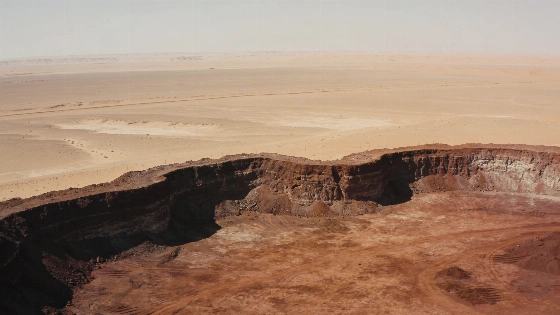
Eight months later, independent images showed little more than an empty crater in the desert. They showed no working infrastructure or machinery, and no workforce was visible.