
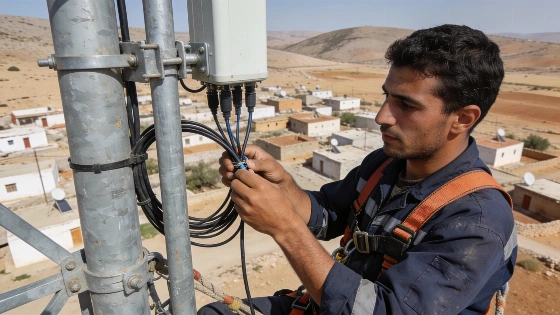
Algeria's telecom regulator has opened a national tender to extend mobile wireless coverage to 3000 underserved areas, aiming to close the digital gap and enable internet access for isolated communities long left behind by infrastructure investment.
Algeria's digital divide is about to face its toughest test yet. The country's Postal and Electronic Communications Regulatory Authority (ARPCE) has triggered a nationwide tender to bring mobile wireless networks to 3000 of the most isolated and sparsely populated areas-territories where connectivity has remained a distant promise for years.
This move is not just a technical upgrade. It is a direct intervention in the country's persistent infrastructure gap, targeting communities that have been systematically excluded from Algeria's digital economy. The regulator's decision, announced on 7 September 2026, is anchored in Law No. 18-04 of May 10, 2018, which mandates universal access to electronic communications. The law's intent is clear: where market forces fail, the state must step in.
Regulatory push to bridge the digital gap
ARPCE's competitive bidding process is designed to force the hand of operators, compelling them to serve regions where low population density has made network deployment commercially unattractive. The regulator is leveraging its legal mandate to ensure that geography no longer dictates who gets online and who remains cut off. The tender's scope-3000 localities-signals a scale of ambition rarely seen in Algeria's telecom sector.
By focusing on universal service, the programme aims to erase the digital borderlines that have split Algeria's urban and rural populations. The government's broader strategy is to reduce disparities in digital access, a goal that has eluded previous infrastructure rollouts. The regulator expects that improved connectivity will not only deliver basic internet access but also unlock new opportunities for social and economic participation in these communities.
Economic and social stakes for underserved regions
The consequences of this initiative extend far beyond faster downloads. For residents of these 3000 areas, mobile coverage could mean access to online education, digital banking, e-government services, and new channels for local business. The ARPCE claims the expansion will support digital, social, and economic development-an assertion that, if realised, could shift the trajectory of entire regions.
Algeria's approach stands in contrast to the piecemeal connectivity efforts seen elsewhere in North Africa. While some countries have focused on urban upgrades or flagship projects, ARPCE's tender is a direct attempt to address structural exclusion. The regulator's insistence that "access to electronic communications services is not determined by where people live" is more than rhetoric; it is a test of the state's capacity to deliver on its own legal commitments.
Efforts to close infrastructure gaps have become a recurring theme across the region, as seen in recent coverage of cross-border business initiatives. But Algeria's latest move is notable for its scale and its explicit focus on the most neglected communities.
What happens next
The tender process will reveal whether Algeria's telecom operators are willing-or able-to meet the regulator's demands. The outcome will be a litmus test for the effectiveness of state-driven digital inclusion policies in a market where commercial logic has long dictated infrastructure priorities. If ARPCE can enforce its mandate and see this project through to completion, it will mark a rare victory for universal service in the Maghreb. But if the initiative stalls or is watered down, it will expose the limits of regulatory ambition in the face of entrenched market realities. For now, Algeria's underserved communities are watching to see if this promise of connectivity finally becomes more than a headline.