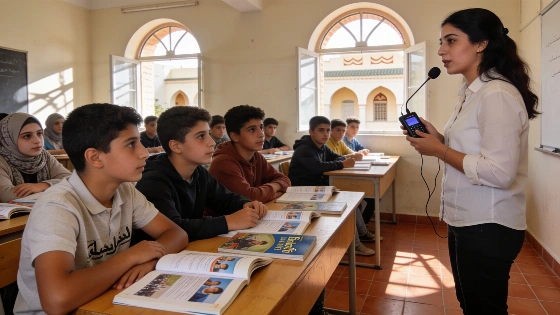
Algeria's Ministry of Education will introduce a revamped English curriculum for second year middle school students in 2026, expanding weekly instruction to 3.5 hours and mandating a shift toward practical communication and digital learning tools.
Algeria's Ministry of Education is set to disrupt the status quo in language instruction by rolling out a new English curriculum for second year middle school students starting in the 2026-2027 academic year. The reform is not a minor adjustment-it marks a decisive move to embed English as a functional skill, not just a theoretical subject, across the country's public and private education systems.
At the heart of the overhaul is a significant increase in classroom time: English will now be taught for 3.5 hours per week, with sessions distributed evenly to ensure consistent exposure and retention. The Ministry's directive, formalised in a note dated 3 September 2026, leaves little room for improvisation. School heads and teachers are required to download and implement the new materials directly from the national education information system, signalling a top-down push for uniformity and immediate compliance.
From Theory to Practice
The new curriculum abandons the old model of rote learning in favour of a dual-track approach that fuses oral and written skills. The communicative method is designed to immerse students in real-life English usage, prioritising listening and speaking over passive memorisation. Meanwhile, written exercises will target reading comprehension and practical writing, aiming to produce students who can actually use English in daily situations rather than simply recite grammar rules.
Supporting this shift, the Ministry has mandated three core resources: a newly developed student textbook tailored to the revised competencies, a comprehensive teacher's guide with planning strategies and methodologies, and a digital audio package featuring diverse listening materials. The expectation is clear-teachers must integrate these tools into every lesson, with no exceptions for laggards or traditionalists.
Implementation and Accountability
To ensure the reform does not stall at the classroom door, the Ministry is deploying subject inspectors to lead mandatory training sessions for English teachers at the start of the school year. These workshops will focus on mastering the new content, adopting the prescribed teaching methods, and using the digital audio resources effectively. A critical component will be diagnosing and addressing learning gaps, especially for students who struggled with the first year of the new English track introduced in 2025-2026.
Regular pedagogical meetings are set to become the norm, with teachers expected to identify class-specific weaknesses and develop targeted support plans for students at risk of falling behind. The Ministry's approach is uncompromising: adaptation is not optional, and accountability will be enforced through ongoing oversight.
Strategic Stakes and Regional Context
This curriculum reform is not happening in a vacuum. Algeria's education sector has faced mounting scrutiny over its ability to modernise and deliver practical skills, especially as neighbouring countries accelerate their own language and digital education initiatives. The Ministry's insistence on digital audio resources and structured teacher training echoes concerns raised in recent reporting about systemic gaps in infrastructure and staff readiness for broader educational reforms.
For students, the stakes are immediate: those who cannot adapt to the new English requirements risk being left behind in a system that is rapidly raising the bar. For teachers and administrators, the message is unmistakable-resistance to change will not be tolerated, and the Ministry will monitor compliance closely.
Algeria's English curriculum overhaul is a calculated move to close the gap with regional peers and equip its youth with skills demanded by a globalised economy. The real test will be whether the Ministry's top-down enforcement and resource-heavy approach can overcome entrenched habits and deliver the promised leap in language proficiency. If implementation falters, the reform risks becoming another well-intentioned directive lost in bureaucratic translation. But if the system delivers, Algeria could finally break the cycle of language stagnation and set a new standard for practical education in the Maghreb.