
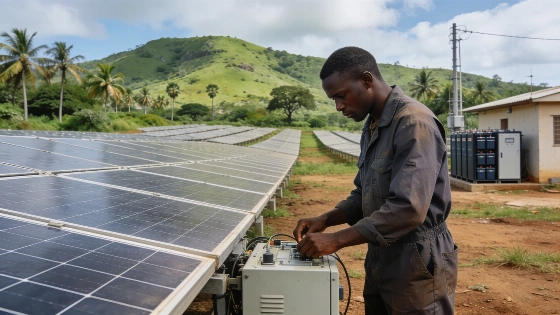
Three solar power plants with battery storage have gone live in the Comoros, targeting a 13 percent share of national electricity demand and aiming to reduce the country's near-total dependence on imported diesel. The project is financed by the UAE and operated by Global South Utilities.
For the first time, the Comoros has switched on three grid-scale solar power plants, a move that directly challenges the country's overwhelming dependence on imported diesel and chronic power shortages. The new facilities, with a combined capacity of nearly 20 megawatts, are expected to supply enough clean electricity for 17,500 households and cut annual carbon emissions by over 20,000 tonnes.
Until now, diesel accounted for 91 percent of the Comorian energy mix, leaving the archipelago exposed to volatile fuel prices and frequent blackouts-over 3,000 outages were recorded last year alone. The new solar plants, distributed across Grande Comore, Anjouan, and Mohéli, are designed to deliver 33.75 gigawatt-hours of electricity per year, representing 13 percent of national demand and 22.5 percent of current effective production.
UAE capital and Global South Utilities take the lead
The project is financed by the Abu Dhabi Fund for Development, with an investment of roughly 84.4 million Emirati dirhams. Construction was led by Abu Dhabi Future Energy Company "Masdar", while operational responsibility now rests with Global South Utilities. The plants are supported by battery storage systems totalling 16 megawatt-hours, installed on Grande Comore and Anjouan, and nearly 30 kilometres of new 20-kilovolt medium-voltage lines to reinforce the grid.
President Azali Assoumani, inaugurating the plants, called the project a "major step" for sustainable development and a testament to the partnership between the Union of the Comoros and the United Arab Emirates. Ali Abdallah Al Shimmari, CEO of Global South Utilities, described the initiative as a model for international renewable energy cooperation, highlighting the integration of solar generation, battery storage, and grid upgrades as key to improving supply reliability.
Energy security and economic impact
The Comorian electricity sector has long struggled with underproduction and instability. In 2024, national demand reached 254 gigawatt-hours, but actual generation lagged at just 150 gigawatt-hours. The new solar plants are expected to reduce fuel import costs, stabilise the grid, and support both economic activity and public services. The scale of the intervention stands out in a region where energy insecurity remains a persistent risk, as seen in recent outages in Mauritania.
With battery storage now in place, the Comoros can smooth out solar variability and reduce the frequency of blackouts that have hampered businesses and households. The project's technical design-12.86 megawatts on Grande Comore, 4.05 megawatts on Anjouan, and 3.1 megawatts on Mohéli-reflects a deliberate effort to distribute benefits across the archipelago's main islands.
Strategic signals and regional context
This investment signals a shift in the Comoros' energy strategy, leveraging Gulf capital and technical expertise to address a structural vulnerability. The partnership with the United Arab Emirates is not just financial; it is a calculated move to secure long-term energy resilience and open new economic opportunities. While the plants will not eliminate diesel overnight, they mark a decisive break from the status quo and set a precedent for other small island states facing similar constraints. The real test will be whether the Comorian authorities and their partners can maintain operational reliability and scale up further, or whether the archipelago will remain at the mercy of imported fuel and grid instability. For now, the Comoros has delivered a rare example of Gulf-backed infrastructure that promises tangible, measurable impact for its citizens-and a warning to regional peers that energy dependence is a choice, not a destiny.