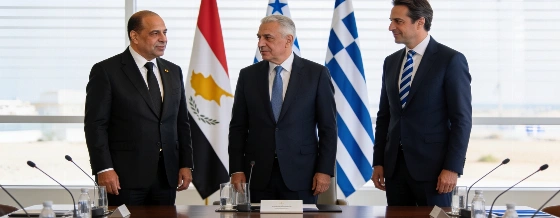
Egypt, Cyprus, and Greece have restated their demand that all maritime agreements in the Eastern Mediterranean follow UNCLOS and international law. The leaders also urged the removal of foreign forces from Libya and called for quicker progress on shared energy projects.
At their summit in El Alamein on 8 September 2026, Egypt, Cyprus, and Greece made it clear that any future maritime agreements in the Eastern Mediterranean must comply with the United Nations Convention on the Law of the Sea (UNCLOS). This position, aimed especially at Turkey and its 2019 maritime deal with Libya, was closely watched by regional media, including the Algerian Press Service and Tunis Afrique Presse, given the stakes for North African maritime claims and energy routes.
The joint statement, signed by Egyptian President Abdel Fattah el-Sisi, Cypriot President Nikos Christodoulides, and Greek Prime Minister Kyriakos Mitsotakis, leaves little doubt: only agreements that respect UNCLOS and the group's earlier principles will be accepted. While Turkey is not named directly, the message is pointed. Ankara, which has not signed UNCLOS, continues to defend its maritime agreement with Libya, a deal Athens and Nicosia reject. According to the Greek Prime Minister's office, the summit's language was chosen to underline the primacy of international law in the region's maritime disputes.
Maritime boundaries and the unresolved Turkey-Libya deal
The main dispute centers on the 2019 Turkey-Libya memorandum, which sets out a maritime boundary across the Eastern Mediterranean. Greece and Cyprus have repeatedly called this agreement invalid, saying it ignores their territorial waters and the presence of Greek islands. The summit's language echoes the January 2025 Cairo declaration, showing a united front against what they see as unilateral moves. Greece has restored diplomatic ties with Libya but insists that geography, not "artificial lines on maps," should set boundaries-a view shared in Maghreb diplomatic circles and reported by Ahram Online.
Though the declaration avoids direct confrontation, the intent is clear: Egypt, Cyprus, and Greece will not accept any maritime deal that sidesteps international law. This stance shapes the legal and diplomatic context for future energy exploration, pipeline planning, and security arrangements. The 2020 Egypt-Greece partial delimitation agreement, cited by Mitsotakis, is offered as proof that such disputes can be settled through negotiation and respect for international rules-a point also raised by the African Union's Peace and Security Council, which has called for legal clarity in cross-border resource management.
Libya, foreign forces, and energy infrastructure
The summit also called for the immediate withdrawal of all foreign forces and mercenaries from Libya, backing a Libyan-led political process and simultaneous presidential and parliamentary elections. The demand for outside actors to leave is a direct response to ongoing foreign military involvement, which has stalled Libya's political transition. Both the Libyan Foreign Ministry and the UN Economic Commission for Africa have stressed that regional stability is key for North African economic integration.
Energy cooperation was another focus. The three countries backed rapid progress on the Greece-Egypt GREGY electricity interconnector and urged completion of links between Cypriot gas fields and Egyptian gas infrastructure. Egypt and Cyprus are already working together on projects tied to the Aphrodite and Cronos fields, aiming to make the region a major energy corridor. According to a recent Euronews business report, exporting Cypriot gas through Egyptian LNG terminals will be an early test of how legal frameworks affect future energy flows to Europe.
Cyprus settlement and regional diplomacy
On Cyprus, the declaration supports the UN secretary-general's efforts and calls for a comprehensive settlement within the UN framework. Unlike the January 2025 statement, this text does not mention a bizonal, bicommunal federation, signaling a shift in diplomatic language while still tying any solution to UN Security Council resolutions. This approach matches the positions of several Maghreb states, which have also backed UN-led solutions to regional disputes, as reported by Morocco's MAP news agency.
Other regional issues were briefly addressed. The leaders supported the second phase of the US plan for Gaza, which calls for a Palestinian state along the 4 June 1967 lines with East Jerusalem as its capital, and urged implementation of UN Security Council Resolution 1701 in Lebanon. Economic cooperation, migration, and water security were also listed as areas for closer trilateral work. The summit's communique was widely covered by regional outlets, including the Egyptian State Information Service, reflecting the growing role of legal and economic frameworks in shaping North African and Eastern Mediterranean politics.
For those following the region's shifting alliances and legal disputes, the summit's outcome is clear: Egypt, Cyprus, and Greece intend to set the legal terms for maritime and energy deals in the Eastern Mediterranean, regardless of Turkish objections. Insisting on UNCLOS compliance is not just a diplomatic stance-it is a requirement for any future cross-border infrastructure or resource development. As with the recent gold seizure in Casablanca, legal frameworks are becoming the main battleground for influence in the region. The question now is whether this trilateral front can turn legal declarations into real, enforceable outcomes, especially as energy interests and foreign military involvement continue to overlap in the Mediterranean.