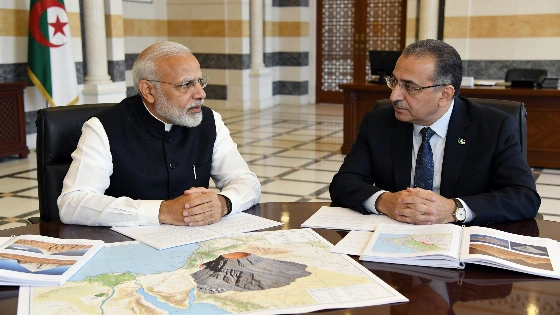
India is moving to deepen its economic footprint in Algeria by prioritising technology transfer and joint ventures in the mining sector, as Ambassador Swati Vijay Kulkarni calls for a concrete action plan to modernise Algeria's mineral value chain.
India is no longer content with symbolic diplomatic ties in North Africa. This week, Indian Ambassador Swati Vijay Kulkarni made clear that New Delhi is ready to move from rhetoric to action, urging the launch of a joint action plan to accelerate technology transfer and investment in Algeria's mining sector. The message: India wants a seat at the table as Algeria opens its mineral resources to foreign partners under a new investment-friendly legal framework.
Algeria's Ministry of Mines and Mining Industries hosted Kulkarni for direct talks with Minister Mourad Hanifi, where both sides dissected the mechanics of bilateral cooperation. The focus was not on vague promises but on operational steps-joint research, geological mapping, and advanced mining projects. Kulkarni stated India's readiness to deploy its companies' expertise to modernise Algeria's mining value chain, aligning with Algiers' stated ambition to shift toward high value-added activities.
Algeria's new mining law draws Indian capital
What's changed is Algeria's legislative environment. Recent reforms have made the country's mining sector more attractive to foreign investors, and Indian economic operators are among the first to signal concrete interest. The Indian ambassador highlighted that major Indian institutions are actively evaluating opportunities, with the new legal framework serving as a catalyst for potential joint ventures and technology partnerships.
Both governments are now under pressure to translate these intentions into measurable outcomes. The proposed joint action plan is designed to move beyond diplomatic statements and deliver tangible projects-especially in mining research, geological mapping, and exploitation. This approach mirrors the pragmatic business engagement seen in other regional partnerships, such as the Spanish-Libyan business mission reported earlier.
Strategic stakes for both countries
For Algeria, the stakes are clear: attract foreign capital and expertise to modernise its mining sector, diversify the economy, and reduce dependence on hydrocarbons. For India, the partnership offers a strategic foothold in Africa's resource landscape, with the added benefit of strengthening its presence in a region where global competition is intensifying.
This mining push is not an isolated initiative. It fits into a broader Algerian-Indian relationship that already spans energy, pharmaceuticals, defence, space technology, infrastructure, and trade. Both sides are now expected to prioritise operational delivery-joint projects, technology transfer, and measurable investment-over ceremonial declarations.
India's willingness to move quickly and concretely in Algeria's mining sector signals a shift in how external powers approach North African partnerships. If the joint action plan materialises into real projects, it will mark a rare example of a non-Western power leveraging technology and investment to gain strategic influence in the Maghreb. The next months will reveal whether this is a turning point or another round of unfulfilled promises, but the intent from New Delhi is unmistakable: India wants to be a serious player in Algeria's economic transformation, and it is prepared to back words with action.