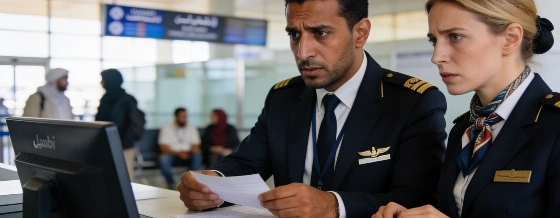
Libya is withholding US$ 25 million in international airline funds, placing it among the most restrictive countries for airline revenue repatriation. The move intensifies operational and financial risks for foreign carriers as regulatory and currency barriers persist.
Foreign airlines flying to Libya are unable to access US$ 25 million of their own earnings, which remain stuck inside the country with no clear way out. The International Air Transport Association (IATA) lists Libya among the toughest places in the world for airlines to recover their revenues, alongside Algeria, Chad, Gabon, Yemen, and Iran. The African Airlines Association (AFRAA) reports that this is a widespread problem: as of March 2026, African governments together are holding about US$ 774 million in airline funds, a persistent risk for carriers across Africa and the Middle East (AFRAA estimates).
These are not just numbers on a balance sheet. The blocked funds come from real ticket sales, cargo fees, and other commercial activities. Airlines have earned this money in Libyan dinars, but cannot convert it into US dollars. Without access to these funds, airlines struggle to pay for essentials like aircraft leases, fuel, maintenance, and salaries-costs that are almost always in hard currency. IATA has repeatedly pointed out that these restrictions break international air service agreements, which require countries to let foreign airlines move their money out. Similar problems have been reported in Tunisia, where currency controls and tax barriers have also discouraged foreign investment in aviation, according to the Tunis Afrique Presse (TAP) agency.
Regulatory chokehold and economic fallout
The main cause is Libya's ongoing economic turmoil and the Central Bank of Libya's (CBL) strict control over foreign exchange. The CBL's August 2026 report shows national revenues at 98.98 billion Libyan dinars, with oil sales making up the bulk-80.8 billion from oil and 15.3 billion from royalties (CBL revenue data). Airlines are caught by currency controls and regulations that block them from converting and transferring their earnings. International treaties and bilateral air service agreements are supposed to guarantee airlines the right to repatriate their revenues, but Libya's current rules break these commitments and leave airlines exposed to exchange rate swings and operational uncertainty. Algeria, another country cited by IATA, has similar currency controls, making regional aviation even more complicated, as noted by the Algerian Press Service (APS).
This is not just a Libyan issue. Tunisia, for example, has seen its investment climate worsen, with red tape and tax barriers pushing away foreign capital (reported earlier). Libya's aviation sector now faces the same problems, with international airlines forced to navigate a maze of regulations that threaten their profits. The Moroccan news agency MAP has reported on ongoing talks within the African Union and the UN Economic Commission for Africa (UNECA) about the need for more consistent aviation policies and better financial transparency across the Maghreb.
Flight bans and limited international access
The financial squeeze is made worse by the European Union's ongoing flight ban, which blocks Libyan airlines from scheduled flights to Europe and prevents EU airlines from running scheduled services to Libya. Despite this, some Libyan-owned and Malta-registered operators-such as MedSky and Libyan Express-have kept charter flights running to places like Malta, Rome, Milan, Athens, Madrid, Dusseldorf, and Paris. MedSky is planning direct flights to Sarajevo and Paris, while Libyan Express has started new routes to Malta, Rome, and Milan. Libyan Airlines is working to recover three grounded aircraft after settling debts and is looking at a possible return to Syria and expansion into Asian markets. The US Federal Aviation Administration currently allows only limited overflights of Libyan airspace.
For Libya's aviation sector, returning to normal operations will not be easy. Lifting the EU flight ban will require coordinated reforms, and current meetings and forums are focused on finding practical solutions. Until then, regulatory and currency barriers will keep deterring foreign airlines and limit Libya's connections to the rest of the world. Regional aviation authorities, including the Tunisian Ministry of Transport and the Moroccan Civil Aviation Directorate, have repeatedly called for better alignment with international standards to rebuild investor trust and improve air links across North Africa.
Libya's decision to hold back US$ 25 million in airline funds is more than a bureaucratic hurdle. It signals to the global aviation industry that the country remains a risky place for international business. Unless the Central Bank of Libya and government officials act to restore currency convertibility and regulatory stability, foreign airlines are likely to stay away, and Libya's isolation from global air networks will continue.