Libya's Central Bank Governor Naji Issa and Prime Minister Abdel Hamid Aldabaiba have reiterated their commitment to the US-brokered Unified Spending Agreement, aiming to strengthen fiscal and monetary coordination and ensure compliance with agreed financial measures.
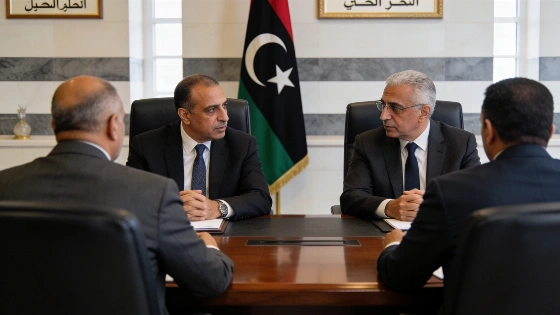
The Governor of the Central Bank of Libya (CBL), Naji Issa, met Prime Minister Abdel Hamid Aldabaiba in Tripoli to review the country’s economic and financial situation. The Minister of Transport and the Minister of State for Communication and Political Affairs also attended. Their discussions focused on coordinating fiscal and monetary policy as Libya seeks to stabilise public finances amid divided fiscal institutions and competing eastern and western administrations.
The meeting addressed monitoring public revenues and expenditure and implementing the US-brokered Unified Development (Spending) Agreement. The agreement is part of an effort to establish a shared structure for public spending across the political divide. US special adviser Massad Boulos has been involved in diplomatic aide. In April 2026, a unified national budget valued at 190 billion Libyan dinars, approximately $29.95 billion, was approved. Central Bank Governor Naji Issa described the initiative as “a clear declaration that Libya is capable of overcoming its differences when a unified vision for its future is forged”.
Both sides reviewed compliance with the agreement’s provisions and areas where implementation has fallen short. The budget arrangement was described as the first unified budget since 2013, while other reporting dates the previous unified-budget effort to 2014. The agreement sets a structure for financial coordination, but its execution depends on continued cooperation between politically divided institutions.
Government Signals Support for Unified Spending Structure
The Central Bank said Aldabaiba reaffirmed his government’s support for the Unified Development Agreement and pledged to implement it. He stressed the need to address shortcomings and meet the agreement’s objectives, while calling for transparency and accountability in public spending.
Libya’s reliance on hydrocarbons heightens the scale of the challenge. World Bank figures for 2024 put oil’s contribution at 65% of GDP, while oil accounted for 93% of exports. It also generated 72% of government revenue. The International Monetary Fund estimated the budget deficit at about 30% of GDP in 2025 and reported public debt at 146% of GDP over the preceding two years. It urged fiscal adjustment to ease pressure on foreign-exchange reserves, the Libyan dinar and inflation.
Revenue actually reaching the Central Bank is a separate measure from oil income generated or reported. The CBL said deposits of oil revenue into its accounts had reached $934 million by 18 October 2026. The Central Bank’s revenue statement was issued in response to a statement involving the House of Representatives and the High Council of State.
Continued Coordination to Support Economic Stability
Participants underlined the need for continued coordination between the Central Bank and the government, and agreed to monitor the measures closely. Libya’s House of Representatives has also discussed steps linked to spending coordination, including a unified salary scale and a general import budget. It has also considered exchange-rate policy and controls to keep expenditure within approved allocations. The House speaker directed the Planning and Finance Committee to coordinate with the Central Bank on these issues. The measures form part of wider deliberations on implementation.
Monitoring revenue deposits will remain basic to putting the unified structure into practice, alongside payroll arrangements and spending controls. The agreement is intended to support development spending across the country, but does not resolve the institutional divisions that continue to shape control of state resources and public finances.