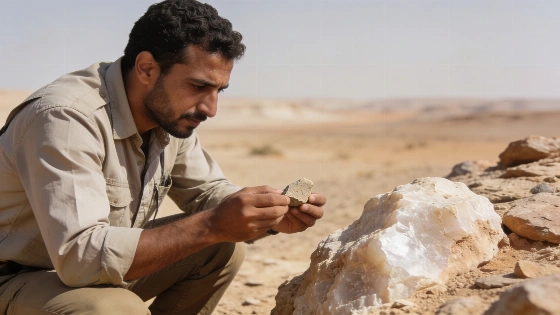
Libya's National Mining Corporation is inviting local and international firms to assess Jaghbub's mineral potential. Initial sampling has flagged several materials for study, while the branch says no commercial reserves have been proven.
Reconnaissance sampling in Jaghbub has yielded initial chemical analyses that point to several minerals for further study. The Al-Butnan branch says the results are preliminary and do not establish proven commercial reserves.
The area lies in eastern Libya near the Egyptian border. The branch is seeking partners to examine its mineral potential through technical studies and possible investment projects. Jaghbub has also featured in reporting on wider strategic developments: a November 2026 report by Libya Observer cited an Al Jazeera investigation based on satellite imagery that identified construction of a new airbase in the oasis.
What the early tests indicate
The indicators include lithium, silica, rock salt and mineral salts, gypsum and calcium sulphates, plus clay materials and associated components. Each requires further assessment: lithium needs confirmatory analyses, while silica's purity and processability remain to be evaluated.
The branch presents the findings as an initial phase of reconnaissance and assessment. They do not establish the size, quality or economic viability of any deposit.
Partnership call leaves feasibility open
The invitation is directed to local and international companies working in exploration or mining, mineral processing or downstream manufacturing. The branch says collaboration could support additional technical and exploratory studies and the development of investment projects based on the region's potential.
For prospective U.S. participants, the U.S. Libya Sanctions Regulations address transactions involving illicit exploitation of crude oil or other natural resources in Libya. The rule is set out in 31 CFR Part 570.
Further work would require specialised companies, research centres and accredited laboratories to complete comprehensive analyses and assess economic feasibility. Maghreb Insider has separately reported on a building-code workshop intended to identify institutional gaps before drafting a code.